I am stalling around before going on line and dealing with Unemployment.
So I have a question. I have a lot of trouble with perfectionism when I revise. There is sometimes, maybe even often, when things are going well, a high when I do the original draft.
But when I go back, all I can see is problems.
Do other people have this reaction? What do they do?
Thursday, April 30, 2009

48,000 words or bust
That's today's editing goal. We'll see. If I manage it I can email my manuscript to my editor exactly a month and a day early.
Monday, April 27, 2009
Monday Morning WIP Open Thread
Hey all,
Whatcha doin'? Huh? Huh? Huh?
I'm getting started on turning beta comments into a draft to send to my editor, because, hey it's about that time. I've got 6 of 11 sets of comments in with another expected tonight. Then...I really don't know, but I ought to update my website and get ready for the book that comes out next month. On the house front. The basement is clean and the dampish wall has been sealed. Hopefully that works. Then it's spread the wood chips from the dump and start thinking about replacing all the counters with salvaged butcher block--but that's at least a month or two out.
Your turn. Oh, and feel free to toss in writing questions. Business, craft, whatever.
Whatcha doin'? Huh? Huh? Huh?
I'm getting started on turning beta comments into a draft to send to my editor, because, hey it's about that time. I've got 6 of 11 sets of comments in with another expected tonight. Then...I really don't know, but I ought to update my website and get ready for the book that comes out next month. On the house front. The basement is clean and the dampish wall has been sealed. Hopefully that works. Then it's spread the wood chips from the dump and start thinking about replacing all the counters with salvaged butcher block--but that's at least a month or two out.
Your turn. Oh, and feel free to toss in writing questions. Business, craft, whatever.
Sunday, April 26, 2009
Novel Length
Kelly found a good post on novel lengths, which he linked to below. A bit discouraging to me. As I age, I want to write shorter and shorter novels. Less is more.
I clearly need to switch over to YA and middle school. I have the beginning of a YA fantasy, which I dropped because my job was eating my life. Maybe I should take another look at it.
There is much to be said for writing a science fiction YA, since these are as rare as hen's teeth, while YA fantasies are as common as teeth in therapod dinosaurs.
I'm currently working on a science fiction novella, not YA, which has gotten out of hand and is 38,000 words. This is an almost unsellable length. But I may be able to sell it to a small press as a chapbook. Anyway, I realized that -- at 38,000 words -- it is eight pages short of the Nebula definition of a novel.
Novella is a better category to be in if I am going for a Nebula, since it tends to be an underpopulated category. However, if I want to go for the Philip K. Dick Award, it ought to be a novel. I don't know if the P. K.Dick has a lower limit for length.
So I will finish it, and if the editor who wants to see it takes it, we can decide whether to fatten it up or slim it down. I think the ending needs to be a bit longer;and there are still places where I could trim in the first 50 pages.
I know it sounds arrogant to talk about awards, but I know my work is not commercial; so why not aim for critical acclaim?
I clearly need to switch over to YA and middle school. I have the beginning of a YA fantasy, which I dropped because my job was eating my life. Maybe I should take another look at it.
There is much to be said for writing a science fiction YA, since these are as rare as hen's teeth, while YA fantasies are as common as teeth in therapod dinosaurs.
I'm currently working on a science fiction novella, not YA, which has gotten out of hand and is 38,000 words. This is an almost unsellable length. But I may be able to sell it to a small press as a chapbook. Anyway, I realized that -- at 38,000 words -- it is eight pages short of the Nebula definition of a novel.
Novella is a better category to be in if I am going for a Nebula, since it tends to be an underpopulated category. However, if I want to go for the Philip K. Dick Award, it ought to be a novel. I don't know if the P. K.Dick has a lower limit for length.
So I will finish it, and if the editor who wants to see it takes it, we can decide whether to fatten it up or slim it down. I think the ending needs to be a bit longer;and there are still places where I could trim in the first 50 pages.
I know it sounds arrogant to talk about awards, but I know my work is not commercial; so why not aim for critical acclaim?
Friday, April 24, 2009
Smart Things--Book Length + Update, Editing
Via David Levine, Colleen Lindsay saying smart things about novel length
Updated to add:
Stephanie Zvan saying smart things about what an editor does.
Updated to add:
Stephanie Zvan saying smart things about what an editor does.
Friday Cat Blogging
What do you mean, your chair?
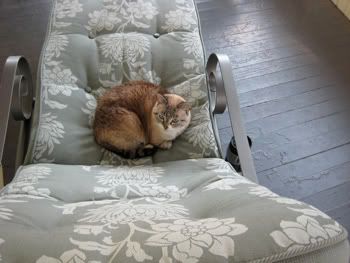
You, down there, prepare to die!
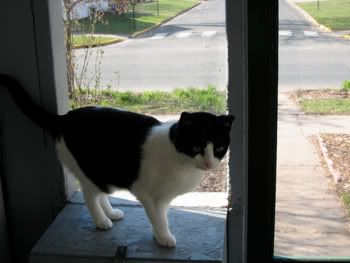
Sun worshiper...duh
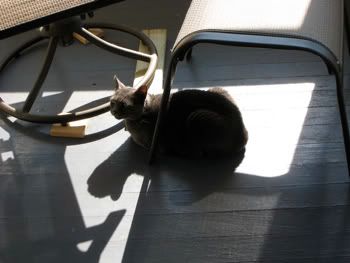
Look, the screen porch is six inches away, don't hassle me about getting out and about.
Up to something? Me? While everyone else is on the porch? Never.

You, down there, prepare to die!

Sun worshiper...duh

Look, the screen porch is six inches away, don't hassle me about getting out and about.

Up to something? Me? While everyone else is on the porch? Never.

Thursday, April 23, 2009
Anchors: Not Just for Ships
I've been arduously reviewing, revising, rereading and generally tweaking my manuscript for HONEYMOON OF THE DEAD, which is due on my editor's desk on May 1. This is the book that I wrote rather quickly (some of you probably remember the contest between Kelly and me,) and I think it shows.
One thing I've discovered today is that there are entire passages with no anchors. "Anchor" is a term I made up (I think!) to describe those little physical details that keep a reader grounded, present or otherwise physically "in" the scene. An actor might call it "blocking," but it's a bit more than just knowing where your characters are in any given scene. It's more like that, plus showing a bit of the scenery or setting.
Fiction, perhaps you've noticed, is entirely text-based (at least at first. At publication you might get a story illustration or cover art....) But until then, it's entirely up to the writer what you see.
"You walk into a room. There are three, very large orcs near the door!"
Yeah, and you know, I never really LIKED being the gamemaster. But now it's my job -- to tell you what you see when *my* characters walk into a room, and to occasionally remind you that all that stuff is still there as the plot goes on. And, ideally, I should be using all those background bits to create a mood that enhances the theme or some other writerly type thing.
Now, I have to go off and do all that.
Wish me luck.
One thing I've discovered today is that there are entire passages with no anchors. "Anchor" is a term I made up (I think!) to describe those little physical details that keep a reader grounded, present or otherwise physically "in" the scene. An actor might call it "blocking," but it's a bit more than just knowing where your characters are in any given scene. It's more like that, plus showing a bit of the scenery or setting.
Fiction, perhaps you've noticed, is entirely text-based (at least at first. At publication you might get a story illustration or cover art....) But until then, it's entirely up to the writer what you see.
"You walk into a room. There are three, very large orcs near the door!"
Yeah, and you know, I never really LIKED being the gamemaster. But now it's my job -- to tell you what you see when *my* characters walk into a room, and to occasionally remind you that all that stuff is still there as the plot goes on. And, ideally, I should be using all those background bits to create a mood that enhances the theme or some other writerly type thing.
Now, I have to go off and do all that.
Wish me luck.
Wednesday, April 22, 2009
Tuesday, April 21, 2009
Covers and Credits (like D&D only it stings more when your characters die)
I just wrote this in regards to a question about queries and not having any professional writing credits:
It's _always_ incredibly difficult to land an agent. But the writing credits issue has very little to do with it. It's something that's very hard to believe when you're first starting out (I certainly had enough trouble getting it into my head) but credits have almost zero impact on acceptances. 99.9999 percent of the time the story gets accepted or doesn't based on its own merits and the current needs of the editor or agent and nothing else really matters. The only exception to that is if you're at the stage in your career where your name sells lots of copies all by itself and that's only true of a very small portion of the folks at the top of the field.
What a writing credit does is tell the editor or agent that you've done this successfully in the past, which has the effect of resorting your place in the submissions stack. I still get rejected by editors all the time–far more often than I got accepted in fact. I just get rejected much faster than the new writer because when I send something in I go to very close to the top of the stack of things to get looked at. Considering the pace of publishing, that's a distinct advantage because it means I can get my work in front of more editors faster, which in turn means that I'm more likely to find the right editor for a piece sooner, but it's an advantage of timing of review, nothing more. Every pro that I know gets rejections, and mostly lots more than they get acceptances.
Okay, that's the bad news. The good news is twofold.
First, agents don't expect to see a whole lot of submissions with credits listed on them. The period in time when a writer is most likely to be looking for an agent is when they're at the beginning of their career and they have no writing credits. Any agent who is actively taking slush is expecting that the vast majority of what they see is going to come in with no credits attached to it and is expecting to make decisions based on the query and the writing. That's just how things work at the beginning of careers, so don't sweat it. Really...yeah, I know. My saying that isn't going to make a lick of difference in the worries department when you're looking at the query and trying to figure out how to make it look better. But try to keep it in mind anyway.
Second, and this is the part that's really really hard to internalize. The agent/editor is on your side. The only people in the whole world who want you to succeed more than an agent or editor do are members of your immediate family. I know that sounds crazy, but it's not. Most agents and editors don't make a whole lot of money and they work horrible hours. They're in the business for the same reason that writers are. They love books with a passion that's very close to unhealthy. There is nothing that makes an agent or editor happier than pulling a book out of the slush, starting to read, and not being able to stop. Every agent or editor I've ever heard talk about finding those gems in the slush pile just lights up. There's actually a thread about it on Making Light right now.
One final note. I started in short stories. The cover letter that I sent with the WebMage short story which started my career was built on top of a blank that Steve Brust showed me when I was starting out. It looked pretty bare and I was nervous about it, but the story sold, and here I am. Here's the letter minus my no longer valid contact info:
Address line 2
phone number
email addy
July 21, 1998*>
George Scithers,
Editor, Weird Tales
123 Crooked Lane,
King of Prussia, PA 19406-2570
Dear George Scithers:
I am enclosing the Contemporary Fantasy short story WebMage for your consideration. I hope that you enjoy it.
Please write or call if you have any questions.
Sincerely,
________________________
Kelly McCullough
That's it. Really, don't sweat the credits. At the beginning of the game they just don't matter.
*portion with <> was top right rather than top left
It's _always_ incredibly difficult to land an agent. But the writing credits issue has very little to do with it. It's something that's very hard to believe when you're first starting out (I certainly had enough trouble getting it into my head) but credits have almost zero impact on acceptances. 99.9999 percent of the time the story gets accepted or doesn't based on its own merits and the current needs of the editor or agent and nothing else really matters. The only exception to that is if you're at the stage in your career where your name sells lots of copies all by itself and that's only true of a very small portion of the folks at the top of the field.
What a writing credit does is tell the editor or agent that you've done this successfully in the past, which has the effect of resorting your place in the submissions stack. I still get rejected by editors all the time–far more often than I got accepted in fact. I just get rejected much faster than the new writer because when I send something in I go to very close to the top of the stack of things to get looked at. Considering the pace of publishing, that's a distinct advantage because it means I can get my work in front of more editors faster, which in turn means that I'm more likely to find the right editor for a piece sooner, but it's an advantage of timing of review, nothing more. Every pro that I know gets rejections, and mostly lots more than they get acceptances.
Okay, that's the bad news. The good news is twofold.
First, agents don't expect to see a whole lot of submissions with credits listed on them. The period in time when a writer is most likely to be looking for an agent is when they're at the beginning of their career and they have no writing credits. Any agent who is actively taking slush is expecting that the vast majority of what they see is going to come in with no credits attached to it and is expecting to make decisions based on the query and the writing. That's just how things work at the beginning of careers, so don't sweat it. Really...yeah, I know. My saying that isn't going to make a lick of difference in the worries department when you're looking at the query and trying to figure out how to make it look better. But try to keep it in mind anyway.
Second, and this is the part that's really really hard to internalize. The agent/editor is on your side. The only people in the whole world who want you to succeed more than an agent or editor do are members of your immediate family. I know that sounds crazy, but it's not. Most agents and editors don't make a whole lot of money and they work horrible hours. They're in the business for the same reason that writers are. They love books with a passion that's very close to unhealthy. There is nothing that makes an agent or editor happier than pulling a book out of the slush, starting to read, and not being able to stop. Every agent or editor I've ever heard talk about finding those gems in the slush pile just lights up. There's actually a thread about it on Making Light right now.
One final note. I started in short stories. The cover letter that I sent with the WebMage short story which started my career was built on top of a blank that Steve Brust showed me when I was starting out. It looked pretty bare and I was nervous about it, but the story sold, and here I am. Here's the letter minus my no longer valid contact info:
Address line 2
phone number
email addy
July 21, 1998*>
George Scithers,
Editor, Weird Tales
123 Crooked Lane,
King of Prussia, PA 19406-2570
Dear George Scithers:
I am enclosing the Contemporary Fantasy short story WebMage for your consideration. I hope that you enjoy it.
Please write or call if you have any questions.
Sincerely,
________________________
Kelly McCullough
That's it. Really, don't sweat the credits. At the beginning of the game they just don't matter.
*portion with <> was top right rather than top left
Monday, April 20, 2009
Guest Blog: A Spy in the House of Love
Yes, Dollhouse fans, this is a review. Well, sort of.
I don't usually do movie or TV reviews. This is only my second one, so forgive me if it's a bit unorthodox. But something about this episode of Dollhouse really spoke to me.
But I'm getting ahead of myself....
I don't know if you have been watching Dollhouse. I have, and while I'm a huge Joss Whedon fan, I have to admit that up until this episode I haven't been impressed. Sure, it has all the basic elements. It has eye candy (Amy Acker – who’s gorgeous even with scars, Tahmoh Penikett, and -- drool -- Eliza), it has action, and it has techno wizzbang, but up until this episode it never really grabbed me, shook me, and said watch me!
Now, I won't go into the whole argument about Fox hosing up the show with their six standalone episode mandate -- that argument has been made and mashed about far enough -- but it does bring to mind something that has been kind of a theme for me this weekend, that all good things come to those who wait.
It's interesting, you know. We live in a culture that is increasingly steering us toward immediate gratification. We can buy nearly anything we want, get the answer to almost any answerable question, or reach out and contact virtually anyone we want, all with a few clicks. We want it -- and we want it now -- and we can have it now.
I think that Dollhouse’s lack of success is a perfect example of what happens in this type of atmosphere. We wanted -- no, we demanded -- that Joss Whedon give us a masterpiece from week one. Well, Fox saw to it that he didn't. But now, three, maybe four episodes after they took off the reins and let him do what he wanted, he has begun to deliver.
The question is, is anyone left around to care?
The ratings say at all. All but the hard-core fans have abandoned this show and really, who can blame them? They/we wanted the immediate gratification of another Buffy, or another Firefly, but we didn't get it.
It all makes me wonder. I know that the book I'm writing isn't an ‘A Spy in the House of Love’. Don't get me wrong, my book is good -- real good, I think -- but it doesn't have the package, you know. It isn't the glitz and glam and techno wizzbang. It's old-school, one of those long, intricate, slowly gestating tales that reaches up at the end and then smacks you in the face.
But really, who has the patience for that sort of thing today?
This post by Shawn Enderlin is licensed under a Creative Commons Attribution-Noncommercial-Share Alike 3.0 United States License.
I don't usually do movie or TV reviews. This is only my second one, so forgive me if it's a bit unorthodox. But something about this episode of Dollhouse really spoke to me.
But I'm getting ahead of myself....
I don't know if you have been watching Dollhouse. I have, and while I'm a huge Joss Whedon fan, I have to admit that up until this episode I haven't been impressed. Sure, it has all the basic elements. It has eye candy (Amy Acker – who’s gorgeous even with scars, Tahmoh Penikett, and -- drool -- Eliza), it has action, and it has techno wizzbang, but up until this episode it never really grabbed me, shook me, and said watch me!
Now, I won't go into the whole argument about Fox hosing up the show with their six standalone episode mandate -- that argument has been made and mashed about far enough -- but it does bring to mind something that has been kind of a theme for me this weekend, that all good things come to those who wait.
It's interesting, you know. We live in a culture that is increasingly steering us toward immediate gratification. We can buy nearly anything we want, get the answer to almost any answerable question, or reach out and contact virtually anyone we want, all with a few clicks. We want it -- and we want it now -- and we can have it now.
I think that Dollhouse’s lack of success is a perfect example of what happens in this type of atmosphere. We wanted -- no, we demanded -- that Joss Whedon give us a masterpiece from week one. Well, Fox saw to it that he didn't. But now, three, maybe four episodes after they took off the reins and let him do what he wanted, he has begun to deliver.
The question is, is anyone left around to care?
The ratings say at all. All but the hard-core fans have abandoned this show and really, who can blame them? They/we wanted the immediate gratification of another Buffy, or another Firefly, but we didn't get it.
It all makes me wonder. I know that the book I'm writing isn't an ‘A Spy in the House of Love’. Don't get me wrong, my book is good -- real good, I think -- but it doesn't have the package, you know. It isn't the glitz and glam and techno wizzbang. It's old-school, one of those long, intricate, slowly gestating tales that reaches up at the end and then smacks you in the face.
But really, who has the patience for that sort of thing today?
This post by Shawn Enderlin is licensed under a Creative Commons Attribution-Noncommercial-Share Alike 3.0 United States License.
Secrets of a NYTimes Bestseller
This is a fascinating, yet sobering post from L. Viehl whose book Twilight Fall made the New York Times Bestseller list. Keeping to a promise to her writer friends, she posted her royalty statement and detailed all her publicity efforts, etc., here: http://www.genreality.net/the-reality-of-a-times-bestseller.
For me, the sobering part is the shear volume of books sold. I've never seen numbers like that in my entire life. And her advance? Holy sh&t!
For me, the sobering part is the shear volume of books sold. I've never seen numbers like that in my entire life. And her advance? Holy sh&t!
What Are You Up To?
It's Monday, and, honestly, I'm having kind of a crappy one. First of all, it's raining in that drizzly, dreary sort of way, which always sort of brings me down. Secondly, my beloved fish are sick (again!). On top of that, our one and only car is in the shop getting some very, VERY expensive, yet necessary work done. (The dumb car and its dangerous struts also caused me to miss Kelly's party on Saturday: All Hail the Red Currant Jelly!)
The only good part of the day is that I'm somewhat stranded at a coffee shop I discovered on Friday, when I first took the car in to get an estimate on what needed to be done. It's called Shish Cafe here in Saint Paul, and it has the most excellent breakfast I've had in a long time and free WiFi. (Hooray!)
However, I could use some cheering up or at least distracting. So tell me! How's your day? What have you got on? Anything fun? Challenging?
The only good part of the day is that I'm somewhat stranded at a coffee shop I discovered on Friday, when I first took the car in to get an estimate on what needed to be done. It's called Shish Cafe here in Saint Paul, and it has the most excellent breakfast I've had in a long time and free WiFi. (Hooray!)
However, I could use some cheering up or at least distracting. So tell me! How's your day? What have you got on? Anything fun? Challenging?
Friday, April 17, 2009


Wednesday, April 15, 2009
Query Info Dump
I got a question about queries and collaborations and figured that the response I put together might be of some interest to folks here. So, with all identifiers removed:
Start with the collaboration stuff:
An agent will deal with a two-author book in pretty much the same way they'd deal with single author book: Does the query make me want to read the material? If so, does the book make me want to represent this(these) client(s)? Then they'll go from there.
My agent reps at least one pair of authors and I know others who do as well. The submission will look pretty much the same as it would if there were only one of you, with the exception that you'll have two names in all the places where there would normally be one. Assuming that you get an agent and they find you a publisher for the book, you might end up under a pen name if the two of you and your agent and publisher decide that's the best way to market the book, but that's a ways down the road. Even in that case, your agent would submit it to editors under both names. Pen names really only come into things after a story or book has sold.
Personally, if it were me, I'd want to put the book out under both names for a variety of reasons, not least of which is that if you ever split your writing partnership up it makes it much easier for both of you to maintain writing careers going forward. Somewhere around here I have a link to some things to think about in terms of contracts for books written as collaborations for books sold before being written (which again would be some distance down the road from where you're at now). If you'd like, I'll see if I can't dig it up. Let me know.
Now on to Queries:
Queries are tough. Part of the reason that you're seeing a hundred different ways to write one is that there really is no standard way to do it. I can point you at a couple of great resources for queries and the plot synopses that go with book proposals. My friend Joshua Palmatier put together a couple of projects where authors in the field posted the query letters that got them their agents http://jpsorrow.livejournal.com/167325.html and the same with synopses http://jpsorrow.livejournal.com/143076.html there's more on the synopsis project including links to stuff I've written on the subject here: http://www.sfnovelists.com/2008/09/19/plot-synopsis-project-ii/
Let me also point you at another set of useful resources. First, Kristin Nelson is a very smart agent who blogs, and she put up a bunch of really fantastic posts on querying and pitching. I've linked some of them here: http://wyrdsmiths.blogspot.com/2008/04/smart-things-pitchingquerying-books.html And of course there's info here. Most of wyrdsmiths writing posts up to about the middle of last year have been indexed by topic here: http://wyrdsmiths.blogspot.com/2007/09/wyrdsmiths-index.html Also, I've put together a topical index of the Miss Snark agent blog which includes tons of good advice on the agent process. That's here:http://wyrdsmiths.blogspot.com/2007/09/truly-garagantuan-miss-snark-index-post.html
That's all for now.
Start with the collaboration stuff:
An agent will deal with a two-author book in pretty much the same way they'd deal with single author book: Does the query make me want to read the material? If so, does the book make me want to represent this(these) client(s)? Then they'll go from there.
My agent reps at least one pair of authors and I know others who do as well. The submission will look pretty much the same as it would if there were only one of you, with the exception that you'll have two names in all the places where there would normally be one. Assuming that you get an agent and they find you a publisher for the book, you might end up under a pen name if the two of you and your agent and publisher decide that's the best way to market the book, but that's a ways down the road. Even in that case, your agent would submit it to editors under both names. Pen names really only come into things after a story or book has sold.
Personally, if it were me, I'd want to put the book out under both names for a variety of reasons, not least of which is that if you ever split your writing partnership up it makes it much easier for both of you to maintain writing careers going forward. Somewhere around here I have a link to some things to think about in terms of contracts for books written as collaborations for books sold before being written (which again would be some distance down the road from where you're at now). If you'd like, I'll see if I can't dig it up. Let me know.
Now on to Queries:
Queries are tough. Part of the reason that you're seeing a hundred different ways to write one is that there really is no standard way to do it. I can point you at a couple of great resources for queries and the plot synopses that go with book proposals. My friend Joshua Palmatier put together a couple of projects where authors in the field posted the query letters that got them their agents http://jpsorrow.livejournal.com/167325.html and the same with synopses http://jpsorrow.livejournal.com/143076.html there's more on the synopsis project including links to stuff I've written on the subject here: http://www.sfnovelists.com/2008/09/19/plot-synopsis-project-ii/
Let me also point you at another set of useful resources. First, Kristin Nelson is a very smart agent who blogs, and she put up a bunch of really fantastic posts on querying and pitching. I've linked some of them here: http://wyrdsmiths.blogspot.com/2008/04/smart-things-pitchingquerying-books.html And of course there's info here. Most of wyrdsmiths writing posts up to about the middle of last year have been indexed by topic here: http://wyrdsmiths.blogspot.com/2007/09/wyrdsmiths-index.html Also, I've put together a topical index of the Miss Snark agent blog which includes tons of good advice on the agent process. That's here:http://wyrdsmiths.blogspot.com/2007/09/truly-garagantuan-miss-snark-index-post.html
That's all for now.
Tuesday, April 14, 2009
Newest Internet Kerfuffle: CandleFAIL!!!!
Check out the newest Internet kerfuffle: CandleFAIL!!
Yes, I'm poking fun at myself. Thanks for noticing.
Yes, I'm poking fun at myself. Thanks for noticing.
Monday, April 13, 2009
"Amazon Fail"
Since all you kids are on Twitter, I'm sure this is old news, but, if somehow you missed it, check out: Amazon Fail. In a nutshell, Amazon.com is apparently removing the sales ranking from books it deems "adult," though read how this has actually played out (ie only queer-friendly books are getting hit) and how it's supposedly "just a glitch."
My thoughts on the matter are pretty simple. Censoring never stopped anyone from being queer (or "adult" for that matter.) We were queer before the Internets and before the printing press. (As I posted on Facebook: "We conquered much of Europe and parts of Asia before we were twenty, thank you very much.") And, though surely it saddens those who prefer a homogeneous world, we'll be queer even if there's some horrifically restrictive apocalyptic future. Censoring our books is not going to change anything.
My thoughts on the matter are pretty simple. Censoring never stopped anyone from being queer (or "adult" for that matter.) We were queer before the Internets and before the printing press. (As I posted on Facebook: "We conquered much of Europe and parts of Asia before we were twenty, thank you very much.") And, though surely it saddens those who prefer a homogeneous world, we'll be queer even if there's some horrifically restrictive apocalyptic future. Censoring our books is not going to change anything.
Kindle, Text to Speech, and the Author's Guild
It is with extreme caution that I dip a toe in these waters, but several people have now asked me what I thought of the Author's Guild position on the Kindle II, and particularly how it may cause real harm to blind or visually impaired readers, and...I do have an opinion. I know that's a shocker, isn't it.
To begin with and just to be absolutely clear, I'm in support of the Kindle's voice feature being generally available. I feel that the benefits to those who have difficulties reading are greater than the potential future hazards to author income.
Now, on to the explanation, which requires some set up. Start with my understanding that (due in part to ADA mandates) all modern American book contracts always include a voice rights for the disabled clause. So, for example, when Minnesota Radio for the blind wanted to broadcast WebMage, that was automatically an allowed usage. I didn't even hear about it until the book had been running on the radio for several weeks. Had it been the case that they'd had to ask, I'd have been delighted to give permission, but that's neither here nor there. The important first point is that audio rights for the disabled are automatic, and I don't know of anyone who is opposed to that.
Next step, the Kindle II and what the author's guild is trying to do. If the Kindle's voice feature was aimed only at the disabled audience I am quite certain that the AG would not oppose this. However, it's a generalized feature and that means that anyone can use it.
Now, an excellent argument can be made that this in no way competes with actual audio book rights because there's simply no comparison between a talented voice actor and a machine conversion of text-to-speech. A counter argument can be made (and this is I think at the core of the AG objection) that that's true now, but...what if in 20 years text-to-speech advances enough that it does become a real competitor? If that happens and no protest was made at this point, a court could well find that in not protesting the Kindle II authors waived their rights to protest the new advanced technology which they are now not going to be paid for. For that matter, what about non-fiction where intonation and story-telling don't really matter?
Since the publishing industry has a long established tradition of grabbing rights and not paying for them, the changing technology puts the AG in the position of either protesting Kindle II in a way that makes them look really bad right now, or not protesting it and possibly causing significant loss of revenues to their membership at some unknown future point, or possibly tomorrow for non-fiction. Now, as I said at the outset, I think the generalized good of allowing the Kindle to use text-to-speech outweighs the possible risks to future authorial income, but at the same time, I sympathize with the fact that it puts the AG between a rock and a hard place. It is not nearly as easy a question as it seems.
So, no, the AG is not insane or evil, just in a difficult position and quite probably wrong.
To begin with and just to be absolutely clear, I'm in support of the Kindle's voice feature being generally available. I feel that the benefits to those who have difficulties reading are greater than the potential future hazards to author income.
Now, on to the explanation, which requires some set up. Start with my understanding that (due in part to ADA mandates) all modern American book contracts always include a voice rights for the disabled clause. So, for example, when Minnesota Radio for the blind wanted to broadcast WebMage, that was automatically an allowed usage. I didn't even hear about it until the book had been running on the radio for several weeks. Had it been the case that they'd had to ask, I'd have been delighted to give permission, but that's neither here nor there. The important first point is that audio rights for the disabled are automatic, and I don't know of anyone who is opposed to that.
Next step, the Kindle II and what the author's guild is trying to do. If the Kindle's voice feature was aimed only at the disabled audience I am quite certain that the AG would not oppose this. However, it's a generalized feature and that means that anyone can use it.
Now, an excellent argument can be made that this in no way competes with actual audio book rights because there's simply no comparison between a talented voice actor and a machine conversion of text-to-speech. A counter argument can be made (and this is I think at the core of the AG objection) that that's true now, but...what if in 20 years text-to-speech advances enough that it does become a real competitor? If that happens and no protest was made at this point, a court could well find that in not protesting the Kindle II authors waived their rights to protest the new advanced technology which they are now not going to be paid for. For that matter, what about non-fiction where intonation and story-telling don't really matter?
Since the publishing industry has a long established tradition of grabbing rights and not paying for them, the changing technology puts the AG in the position of either protesting Kindle II in a way that makes them look really bad right now, or not protesting it and possibly causing significant loss of revenues to their membership at some unknown future point, or possibly tomorrow for non-fiction. Now, as I said at the outset, I think the generalized good of allowing the Kindle to use text-to-speech outweighs the possible risks to future authorial income, but at the same time, I sympathize with the fact that it puts the AG between a rock and a hard place. It is not nearly as easy a question as it seems.
So, no, the AG is not insane or evil, just in a difficult position and quite probably wrong.
Friday, April 10, 2009
Friday Cat Blogging
Watch me do a bunny shadow next!
Okay, now bring me a bucket of fish!
It's my chair now, buddy.
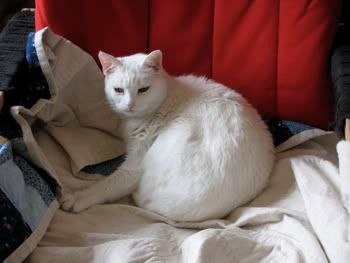
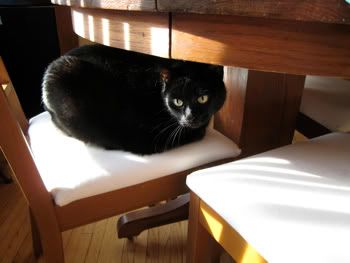
See! I do too fit under here...I just can't get out.
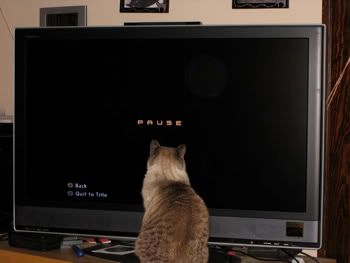
I'm paused. Now, what?
Guess where?

Okay, now bring me a bucket of fish!

It's my chair now, buddy.

See! I do too fit under here...I just can't get out.

I'm paused. Now, what?

Guess where?

Faith
I was going to comment on Doug's post, but my comment kept getting longer and longer. So I am posting here.
I think Doug is almost certainly right about his categories of faith. But I don't think I entirely share his experience.
I treasure the faith that other people have in my work; it's hugely important. I can be made happy for weeks by praise. (I got terrific praise recently from someone who is going -- I think -- to buy my "Mammoth" story for a small press project. It's someone I respect a lot. I am still floating.)
I believe in my stories while I'm writing them, except when I get frustrated and think, "This is crap." I have on several occasions thrown stories out when they were partly done and then rewritten them from memory. One was "The Garden," which ended in a Gardner Dozois Best of the Year collection.
In general, in spite of doubt, this is the strongest faith for me. There are stories that must be told; there are explorations of art which must take place.
I'm not sure how much I believe in myself as a writer. I think at some deep level I do. But closer to the surface I think of myself as someone doing a necessary job with inadequate tools.
I think this is the influence of the 19th/early 20th century legend of the avant garde artist starving in a garret for his art. He is doing something difficult and important that other people don't understand, driven by his inner vision and a fierce integrity, troubled by external criticism and internal self-doubt. Van Gogh is the perfect example.
I grew up with this story, since my father was an art historian who studied 19th and 20th art and who knew a lot of avant garde artists, who actually did live lives kind of like the van Gogh legend, though they suffered less and managed to have wives, who helped their careers a lot.
This is a very different story from the legend of the science fiction writer, the competent, can-do professional, who gets the work done on time and to specification.
Anyway, I think my idea of how to be an artist was shaped by the van Gogh legend and the example of artists like the 20th century painter Philip Guston. You always question. You always doubt. You always push limits. If people don't understand or like what you are doing, that's too bad, but you have to keep following your own vision. And you have plenty of days when self-doubt overwhelms your faith in yourself. But you keep trucking.
I'm not sure I recommend this idea of the artist. I suspect it makes too big a deal of writing, and it may encourage unnecessary self-doubt and suffering.
The sf can-do professional has a lot to be said for it. There are limitations to this idea, but no need to discuss them now.
I think Doug is almost certainly right about his categories of faith. But I don't think I entirely share his experience.
I treasure the faith that other people have in my work; it's hugely important. I can be made happy for weeks by praise. (I got terrific praise recently from someone who is going -- I think -- to buy my "Mammoth" story for a small press project. It's someone I respect a lot. I am still floating.)
I believe in my stories while I'm writing them, except when I get frustrated and think, "This is crap." I have on several occasions thrown stories out when they were partly done and then rewritten them from memory. One was "The Garden," which ended in a Gardner Dozois Best of the Year collection.
In general, in spite of doubt, this is the strongest faith for me. There are stories that must be told; there are explorations of art which must take place.
I'm not sure how much I believe in myself as a writer. I think at some deep level I do. But closer to the surface I think of myself as someone doing a necessary job with inadequate tools.
I think this is the influence of the 19th/early 20th century legend of the avant garde artist starving in a garret for his art. He is doing something difficult and important that other people don't understand, driven by his inner vision and a fierce integrity, troubled by external criticism and internal self-doubt. Van Gogh is the perfect example.
I grew up with this story, since my father was an art historian who studied 19th and 20th art and who knew a lot of avant garde artists, who actually did live lives kind of like the van Gogh legend, though they suffered less and managed to have wives, who helped their careers a lot.
This is a very different story from the legend of the science fiction writer, the competent, can-do professional, who gets the work done on time and to specification.
Anyway, I think my idea of how to be an artist was shaped by the van Gogh legend and the example of artists like the 20th century painter Philip Guston. You always question. You always doubt. You always push limits. If people don't understand or like what you are doing, that's too bad, but you have to keep following your own vision. And you have plenty of days when self-doubt overwhelms your faith in yourself. But you keep trucking.
I'm not sure I recommend this idea of the artist. I suspect it makes too big a deal of writing, and it may encourage unnecessary self-doubt and suffering.
The sf can-do professional has a lot to be said for it. There are limitations to this idea, but no need to discuss them now.
Faith
Back when I started 'Hawthorn Queen' (my current WIP), I got together with Lyda over coffee to do a bit of brain-storming. What I didn't realize at the time was that Lyda did the majority of her surfing/blogging/e-mail at coffee shops, since she was limited to dial-up at home. This meant that Lyda was a bit distracted as we chatted, what with her reading and posting and the like, while I was trying to generate, you know, Ideas. It must have shown, because at one point, Lyda looked up at me and said something along the lines of, "I'm sorry, I'm not giving you a lot of input, am I? But you're a good enough writer that I know you'll figure it out, so I'm not worried."
I smiled and nodded and thanked her at the time, but I wasn't exactly thrilled with the response. I had gotten together to hash out Ideas, and while the ego-stroke was nice, it hadn't been what I was hoping for.*
How little I understood. What Lyda had done was shown me her faith in me as a writer. That's no small thing.
To my mind, there are three core kinds of faith when it comes to writing. All are important, and we need to have a bit off each of them as writers, but in differing degrees.
The first kind of faith what is Lyda provided: Faith from Outside the Writer. This is basically an affirmation from an outside source that says, "I believe in your ability as a writer. I believe you can do this." This can come in the form of words of encouragement from a friend, a signed contract from a publisher, the support of your family, and so on and so forth. This kind of faith is great, and it can help you get through those long, dark passages where nothing seems to sit well on the page; but it is also, to my mind, the most ephemeral of the three faiths, since it is outside the writer. While offered up freely and well meant, this faith alone will not get you to the end of the project. No matter how good the intentions, the belief of others is not going to get words on the paper for you.
The second kind of writing faith is the Faith in the Story. This is a belief in the idea, or the characters, or the concept, or the storyline of the work itself. It is believing that what you are writing is something people will ultimately want to read, or at least something that you want to write. This faith needs to be strong, but also held loosely in the hand. Why? Because, as most of us have found out to our chagrin, not every story is a good story. What starts out with vigor and promise can turn old and tarnished. The slick, slip-stream idea we loved on page one can turn into a Gordian knot of complexities or difficulties by page 20, or 50, or 150. As writers, we need to honestly believe in what we are writing, to have faith in the ideas and characters; but we also need to be able to leave those same ideas and characters on the side of the road sometimes when it is not working out. The trick of this kind of faith is learning when it is time to lose it, as well as not to lose it too early.
The last kind of faith for the writer is Faith in Yourself as a Writer. You are a writer. You can do this. You can write your way out of this bind, or through the plot maze, or past this block. And while you may have the faith of your friends and your faith in the story, at the end of the day, it is you who has tell that story. In the darkest hours, when it is you against the blank page, it is this last faith that is put to the greatest test. And that is why this, of the three, is the one faith that you must hold to your chest and believe in with all your might, even if the other two faiths fall away. You are a writer. You put words on paper to tell a story. You do this, you will do this, and you will keep doing this because it is what you do. It is who you are. On this faith, you cannot compromise.
This is a game of belief. You have to have faith to be a writer: of others, in the story, and, most importantly, in yourself. And while I may say I believe in you, it really comes down to what you believe about yourself. Be a writer. Believe it. Have some faith.
And get to work.
*To be fair, Lyda also gave me a thirty second throw-away idea that became the foundation for the magic system for the entire book, so I can't really fault her in the long run. :)
I smiled and nodded and thanked her at the time, but I wasn't exactly thrilled with the response. I had gotten together to hash out Ideas, and while the ego-stroke was nice, it hadn't been what I was hoping for.*
How little I understood. What Lyda had done was shown me her faith in me as a writer. That's no small thing.
To my mind, there are three core kinds of faith when it comes to writing. All are important, and we need to have a bit off each of them as writers, but in differing degrees.
The first kind of faith what is Lyda provided: Faith from Outside the Writer. This is basically an affirmation from an outside source that says, "I believe in your ability as a writer. I believe you can do this." This can come in the form of words of encouragement from a friend, a signed contract from a publisher, the support of your family, and so on and so forth. This kind of faith is great, and it can help you get through those long, dark passages where nothing seems to sit well on the page; but it is also, to my mind, the most ephemeral of the three faiths, since it is outside the writer. While offered up freely and well meant, this faith alone will not get you to the end of the project. No matter how good the intentions, the belief of others is not going to get words on the paper for you.
The second kind of writing faith is the Faith in the Story. This is a belief in the idea, or the characters, or the concept, or the storyline of the work itself. It is believing that what you are writing is something people will ultimately want to read, or at least something that you want to write. This faith needs to be strong, but also held loosely in the hand. Why? Because, as most of us have found out to our chagrin, not every story is a good story. What starts out with vigor and promise can turn old and tarnished. The slick, slip-stream idea we loved on page one can turn into a Gordian knot of complexities or difficulties by page 20, or 50, or 150. As writers, we need to honestly believe in what we are writing, to have faith in the ideas and characters; but we also need to be able to leave those same ideas and characters on the side of the road sometimes when it is not working out. The trick of this kind of faith is learning when it is time to lose it, as well as not to lose it too early.
The last kind of faith for the writer is Faith in Yourself as a Writer. You are a writer. You can do this. You can write your way out of this bind, or through the plot maze, or past this block. And while you may have the faith of your friends and your faith in the story, at the end of the day, it is you who has tell that story. In the darkest hours, when it is you against the blank page, it is this last faith that is put to the greatest test. And that is why this, of the three, is the one faith that you must hold to your chest and believe in with all your might, even if the other two faiths fall away. You are a writer. You put words on paper to tell a story. You do this, you will do this, and you will keep doing this because it is what you do. It is who you are. On this faith, you cannot compromise.
This is a game of belief. You have to have faith to be a writer: of others, in the story, and, most importantly, in yourself. And while I may say I believe in you, it really comes down to what you believe about yourself. Be a writer. Believe it. Have some faith.
And get to work.
*To be fair, Lyda also gave me a thirty second throw-away idea that became the foundation for the magic system for the entire book, so I can't really fault her in the long run. :)
Thursday, April 09, 2009
New Paying Market That Made Me Smile
I just spotted this in my newest issue of Gila Queen's Guide to Markets, and it made me smile:
---------
---------
Brain Harvest, An Almanac of Bad Ass Speculative Fiction—See Web site. Weekly. "Brain Harvest will publish electronically and can be read right [at the Web site], or dispatched to your iPhone, BlackBerry, or whatever other mobile device—and maybe, one day, straight into your brain."
Lofty guidelines: "We are those jaded m*f*s who've seen everything. We worry about fiction. Where are the new ideas? Where's the weird shit? What's the future going to look like, and why will it matter? Please, surprise us. Shock us out of our ennui, and, like the iconic hooker with a heart of gold, or the free spirit w/terminal illness, help make our lives worth living again."
ADD guidelines: "750 or fewer words. Weird. Surprising. Preferably no elves."
Concrete guidelines: "Brain Harvest is looking for short fiction, 100–750 words. We want well-crafted, interesting stories that do not fall back on old, well-worn tropes—unless they have an interesting, bad-ass take on an old, well-worn trope."
"We are a speculative fiction magazine, and while your submission should have speculative aspects, we're not looking for any particular genre—substance and execution are more important than subject matter. We are not particularly keen on elves or steampunk, but if you have something different to say that requires elves or steampunk, feel free to send it along."
"E-mail submissions as attachments to submissions at [E-mail address below]. Submissions must be submitted in RTF (Rich Text Format) only. If they are in another format, we won't read them."
"Again, 750 words or fewer, please. This doesn't have to include the title."
"In the subject line, please write ‘NAME/TITLE OF SUBMISSION.’"
"No simultaneous submissions. Please only send one submission at a time. When you hear back from us, you may send another. Standard manuscript format is a bonus."
Pays 5¢/word, to $37.50, "by PayPal."
"We accept reprints, but pay for them at a different rate. Please indicate if your submission has been printed elsewhere."
"We do not publish poetry. We may, at some point in the future, publish a special poetry issue, but please do not send us poetry unless we've asked for it. Really."
"Cover letters are nice because we're nosy. But, really, we only need a few lines about who you are and what you're submitting. At this length, quality speaks louder than what you've already done or where you've been."
"We try and keep our response time lightning quick. That being said, if you haven't heard from us within a month, don't be shy. Query us and ask."
Themes: "Once in a while, we will toss a theme out into the arena for a ‘special’ issue. We are brimming with ideas about fiction we wish existed, and this us our opportunity to make that happen. We will announce upcoming themes well in advance of any deadlines we set, and will always continue to read non-themed submissions."
"Other stuff you should know:"
Unpublished work: "By submitting your unpublished work, you understand that, if accepted, Brain Harvest will buy FNASR, which gives is the one-time right to publish the story first in the North American market. Additionally, we will keep the story up in our archives and are allowed to include it in any future anthologies, either electronic or print. We will contact you if we want to use your story in an anthology. You, the author, retain all other rights to the work."
Reprints: "You must own the rights to the work you are submitting. Brain Harvest will buy the rights to reprint your piece in a issue of the magazine and keep the story up in our archives. We will happily give credit to the first/initial publisher of the piece. You, the author, retain all other rights to the work."
"We do not accept artwork, photography, or poetry at this time."
[E-mail: submissions at brainharvestmag dot com; http://www.brainharvestmag.com/].
Wednesday, April 08, 2009
Coffee on Me (and Tate...)
So not only do I need to buy the Wyrdsmiths a round of coffee for Tate's German deal, but I came home last night to an e-mail informing me that "SHE NAILED THE STAKE THROUGH HIS HEAD: TALES OF BIBLICAL HORROR," which is being published by Dybbuk Press (editor Tim Lieder) seems to have accepted my short story "Jawbone of an Ass."
I'm only not entirely sure because when Lieder sent the acceptance e-mail, the editor asked if the story was a reprint or not. I gave him my same information I had when I sent it in (which is "kind of," since it appears in our self-produced, limited edition chapbook New Wyrd), and it's not clear if that's cool or not. I'll keep you posted.
I'm kind of excited because I really, really like this short story of mine (unusual for me. Ask any Wyrdsmith, the short form is usually not my best.) This is not a AngeLINK story, but it does (perhaps obviously) have a religious overtones. Here's a blurb if the story had one: What would it be like to know that God is absolutely *not* on your side? “Jawbone of an Ass” is a modern day retelling of the story of Sampson’s first wife (known only as the woman of Timor), who slowly comes to realize the horror of knowing she, through no fault of her own, is on the wrong side of the wrath of angels.
Go me!
I'm only not entirely sure because when Lieder sent the acceptance e-mail, the editor asked if the story was a reprint or not. I gave him my same information I had when I sent it in (which is "kind of," since it appears in our self-produced, limited edition chapbook New Wyrd), and it's not clear if that's cool or not. I'll keep you posted.
I'm kind of excited because I really, really like this short story of mine (unusual for me. Ask any Wyrdsmith, the short form is usually not my best.) This is not a AngeLINK story, but it does (perhaps obviously) have a religious overtones. Here's a blurb if the story had one: What would it be like to know that God is absolutely *not* on your side? “Jawbone of an Ass” is a modern day retelling of the story of Sampson’s first wife (known only as the woman of Timor), who slowly comes to realize the horror of knowing she, through no fault of her own, is on the wrong side of the wrath of angels.
Go me!
Monday, April 06, 2009
German Sale (My First European Foreign-Language Deal!)

Notwithstanding a Japanese translation of my alter-ego's Archangel Protocol, a British edition of the first three books, and all the various translations of the anthology my short story appeared in (which shouldn't count because I never saw advances for those), this is a first for me:
My agent just informed me that the German publisher VGS publishers want my first four books (Tall, Dark & Dead, Dead Sexy, Romancing the Dead and Dead if I Do) for a paperback original publication under their imprint LYX.
I get paid in Euros. Cool, huh?
Smart Things
Laura Anne Gilman righteously mocks someone trying to profit from beginning writer naivety. it starts about five paragraphs down the page. Very nice takedown of a nasty scam.
Sunday, April 05, 2009
Friday Cat Blogging on Sunday
Belatedly...
Wha...oh, you.
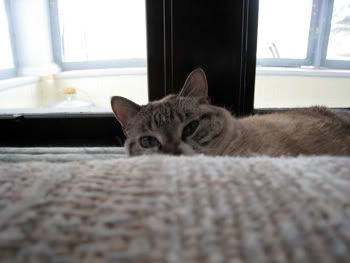
I'm ready for my closeup.
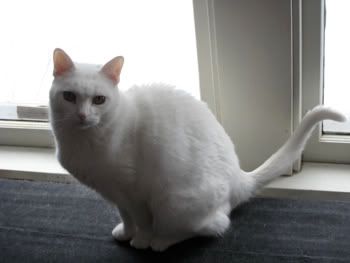
It's snowing and I blame you
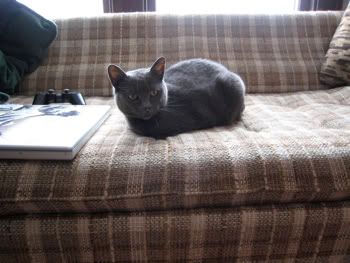
Why yes, I did walk on your breakfast. Why do you ask?
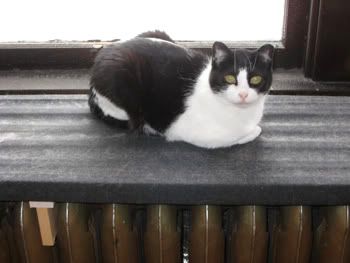
I knows what evil lurks in the hearts of men...me!
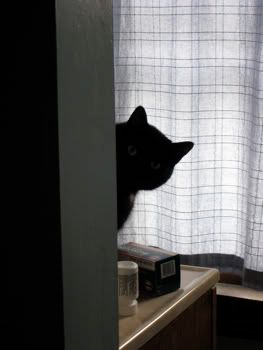
Wha...oh, you.

I'm ready for my closeup.

It's snowing and I blame you

Why yes, I did walk on your breakfast. Why do you ask?

I knows what evil lurks in the hearts of men...me!

Saturday, April 04, 2009
Guest Blog: Creative Commons
I'm a big fan of technology. Like, a “way over-the-top into geek land” fan. I think it all started at the theater when I was six, going on seven. There I was, my jaw on the floor while an Imperial Star Destroyer bore down on Princess Leia's Rebel Blockade Runner. It wasn't exactly a unique moment in the universe, but it was formative!
For me, technology has always been linked with my writing. Back in the day I used to keep all my Dungeons & Dragons character files, all my world-building campaigns, etc. on the family Apple IIgs. Now, too many moons later, I have integrated technology even more deeply into my creative life. I blog occasionally, I Twitter constantly, and I dictate my novel through the use of voice translation software.
Technology has certainly improved the process by which I write, but what about the end product of all that talking to my computer? What do I do with all those blog posts, or with my novel -- assuming I ever get it finished! Can technology and the internet improve that?
This is a question that has intrigued me ever since I first became serious about wanting to turn my writing into a career and I’ve been looking for answers to that question for quite some time. While I still don’t feel like I have a firm answer to the question of how to best leverage technology, I have discovered a few intriguing things and look forward to sharing them with you over my next few blog posts.
The first of these, is something called Creative Commons (http://creativecommons.org/). Creative commons builds on core internet principles such as sharing and reuse and applies them to the domain of intellectual capital.
Taken directly from the Creative Commons website:
“Creative Commons is a nonprofit corporation dedicated to making it easier for people to share and build upon the work of others, consistent with the rules of copyright.
We provide free licenses and other legal tools to mark creative work with the freedom the creator wants it to carry, so others can share, remix, use commercially, or any combination thereof.”
I won't go into all the details surrounding the types of Creative Commons licenses available (you can go to their website to see that), but I will give you the 10,000 foot overview. There are six types Creative Commons licenses, ranging from the least restrictive: a license that lets others redistribute your work, make derivatives of it, and do so for profit, as long as they credit you; to the most restrictive: a license that lets others redistribute your work but not make derivatives, nor do it for profit.
Creative Commons licenses have been legally tested and they have been utilized by many people and corporations, including, the music group Nine Inch Nails and the U.S. Government. In addition, the electronic license widget you add to your online content automatically plugs you into what I call the “Creative Commons Network” making your work available (via search engines such as Firefox) for sharing and reuse, based on the conditions of your license.
So what does that mean to those of us who are writers? It means we can easily and safely secure our creative works without the use of copyright, we can do it for no cost, and we can do it in such a manner that our work becomes easily available to others.
This sort of freedom opens up a whole range of possibilities. Take for example this website. A Creative Commons license can be used to protect all the intellectual capital that exists here. What about those short stories sitting around gathering virtual dust on your hard drive? Slap a Creative Commons license on them and upload them to an internet publishing house or make them available as a free download.
Now, you can see where this is going, right? One could put a Creative Commons license on a novel and then distribute and market that novel via the internet without ever having to interact with a publisher. Of course, there are some major pros and cons to such an approach and a Creative Commons license is only one factor to consider in making such a decision.
So tell me, what do you think about Creative Commons? Have any of you writers used a Creative Commons license before? Has your experience been good or bad? Anyone a playwright? What do you think about being able to legally make derivative works of someone else's novel, short story, etc.? Readers, where have you seen Creative Commons licenses used?
Oh, and by the way: This post by Shawn P. Enderlin is licensed under a Creative Commons Attribution-Noncommercial-Share Alike 3.0 United States License.
For me, technology has always been linked with my writing. Back in the day I used to keep all my Dungeons & Dragons character files, all my world-building campaigns, etc. on the family Apple IIgs. Now, too many moons later, I have integrated technology even more deeply into my creative life. I blog occasionally, I Twitter constantly, and I dictate my novel through the use of voice translation software.
Technology has certainly improved the process by which I write, but what about the end product of all that talking to my computer? What do I do with all those blog posts, or with my novel -- assuming I ever get it finished! Can technology and the internet improve that?
This is a question that has intrigued me ever since I first became serious about wanting to turn my writing into a career and I’ve been looking for answers to that question for quite some time. While I still don’t feel like I have a firm answer to the question of how to best leverage technology, I have discovered a few intriguing things and look forward to sharing them with you over my next few blog posts.
The first of these, is something called Creative Commons (http://creativecommons.org/). Creative commons builds on core internet principles such as sharing and reuse and applies them to the domain of intellectual capital.
Taken directly from the Creative Commons website:
“Creative Commons is a nonprofit corporation dedicated to making it easier for people to share and build upon the work of others, consistent with the rules of copyright.
We provide free licenses and other legal tools to mark creative work with the freedom the creator wants it to carry, so others can share, remix, use commercially, or any combination thereof.”
I won't go into all the details surrounding the types of Creative Commons licenses available (you can go to their website to see that), but I will give you the 10,000 foot overview. There are six types Creative Commons licenses, ranging from the least restrictive: a license that lets others redistribute your work, make derivatives of it, and do so for profit, as long as they credit you; to the most restrictive: a license that lets others redistribute your work but not make derivatives, nor do it for profit.
Creative Commons licenses have been legally tested and they have been utilized by many people and corporations, including, the music group Nine Inch Nails and the U.S. Government. In addition, the electronic license widget you add to your online content automatically plugs you into what I call the “Creative Commons Network” making your work available (via search engines such as Firefox) for sharing and reuse, based on the conditions of your license.
So what does that mean to those of us who are writers? It means we can easily and safely secure our creative works without the use of copyright, we can do it for no cost, and we can do it in such a manner that our work becomes easily available to others.
This sort of freedom opens up a whole range of possibilities. Take for example this website. A Creative Commons license can be used to protect all the intellectual capital that exists here. What about those short stories sitting around gathering virtual dust on your hard drive? Slap a Creative Commons license on them and upload them to an internet publishing house or make them available as a free download.
Now, you can see where this is going, right? One could put a Creative Commons license on a novel and then distribute and market that novel via the internet without ever having to interact with a publisher. Of course, there are some major pros and cons to such an approach and a Creative Commons license is only one factor to consider in making such a decision.
So tell me, what do you think about Creative Commons? Have any of you writers used a Creative Commons license before? Has your experience been good or bad? Anyone a playwright? What do you think about being able to legally make derivative works of someone else's novel, short story, etc.? Readers, where have you seen Creative Commons licenses used?
Oh, and by the way: This post by Shawn P. Enderlin is licensed under a Creative Commons Attribution-Noncommercial-Share Alike 3.0 United States License.
Wednesday, April 01, 2009
Best April Fool's Joke EVER
This made me laugh OUT LOUD (from Tor.com):
Science Fiction World Rocked as Woman Claims No Sexual Attraction to Neil Gaiman.
Clearly a joke, as I can't think of ANYONE not attracted to Neil. (This from a lesbian who has had a boy-crush on him for years.)
Science Fiction World Rocked as Woman Claims No Sexual Attraction to Neil Gaiman.
Clearly a joke, as I can't think of ANYONE not attracted to Neil. (This from a lesbian who has had a boy-crush on him for years.)
Speaking of the Book of Your Enemy...

I just got 4 Stars from Romantic Times Bookreviews!!
Here's what Jill M. Smith has to say about DEAD IF I DO:
"Nothing in the life of Hallaway's heroine every goes exactly as planned, which generally leads to madcap mayhem. This chapter in the first-person series is packed with humor, wackiness and a touch of pathos. It's a genuinely heartwarming treat for fans!"
Go me.
Subscribe to:
Posts (Atom)