On becoming an editor. (I think I snerched this from Charlie Stross)
Kristin Nelson is rocking on ebooks and contract this week. Redefining net receipts. Also, ebooks and royalty statements. And, ebooks and bonus clauses.
Scalzi, being funny and smart while pointing to the Stross publishing series I linked last go round.
In a related post. Scalzi: writers creating jobs.
Carole Baron at Huffpost, talking about things that editors do regardless of publication medium.
Friday, February 26, 2010

Friday Cat Blogging
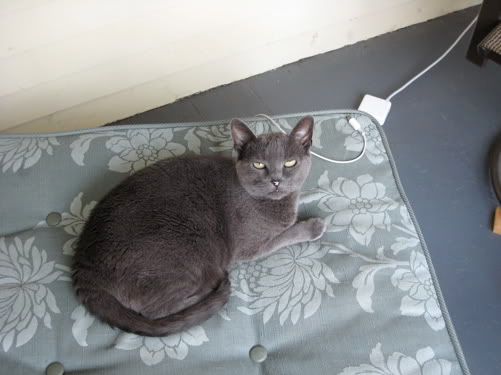
I'm not looking at you.
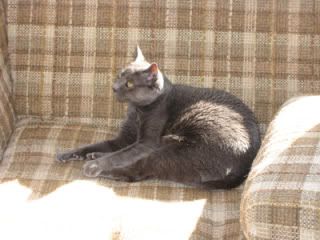
Stitch bit me!
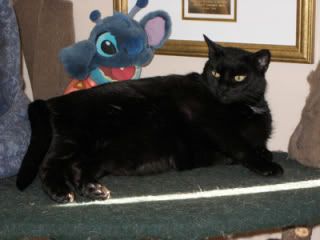
Hold very still, there is a bug on your head. I will kill it now.
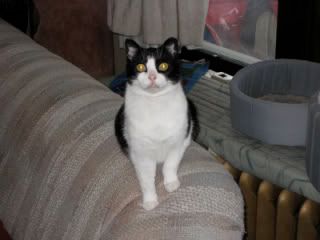
Oh yeah.
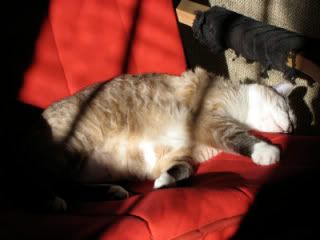
No, I'm really quite comfortable. Why do you ask?
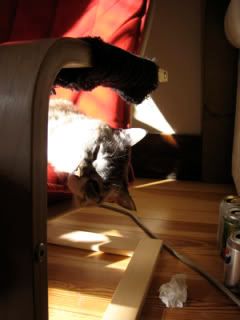

Stitch bit me!

Hold very still, there is a bug on your head. I will kill it now.

Oh yeah.

No, I'm really quite comfortable. Why do you ask?

Thursday, February 25, 2010
Smart Things and Some That Are Merely Cool
David Coe over at SFNovlists talking about loving the work.
Jim Hines also at SFNovelists saying funny things about publishing terminology.
Charlie Stross saying smart things about the ways in which publishing is not like people think it is. Publishing misconceptions, the first in a series. With a very nice assist in comments from C.E. Petit. Ooh, and episode two came in before I posted: How books are made.
And on a related topic, C.E. Petit has a long discussion on copyright and book editions. (snerched from Jay Lake) I haven't fully read this one yet, but I trust both Jay's judgment that it's worth reading if you're a publishing geek and Petit's ability to do the topic justice.
Snerched from my editor, the marvelous Anne Sowards: "behind the scenes at Penguin--"Type Matters", a series of short videos about book designers & fonts." Fascinating stuff, if you're a publishing geek.
Anne Aguirre ranting funnily about things that piss her off. Three down is why I'm linking, because it is funny and smart.
Beth Hangelli being wise about life again.
The very perceptive Angela Kessler is reviving Dreams of Decadence as a general urban fantasy magazine and mentioned me in the submission guidelines as a favorite author and an example of the kind of stuff they're looking for. How cool is that?
Jim Hines also at SFNovelists saying funny things about publishing terminology.
Charlie Stross saying smart things about the ways in which publishing is not like people think it is. Publishing misconceptions, the first in a series. With a very nice assist in comments from C.E. Petit. Ooh, and episode two came in before I posted: How books are made.
And on a related topic, C.E. Petit has a long discussion on copyright and book editions. (snerched from Jay Lake) I haven't fully read this one yet, but I trust both Jay's judgment that it's worth reading if you're a publishing geek and Petit's ability to do the topic justice.
Snerched from my editor, the marvelous Anne Sowards: "behind the scenes at Penguin--"Type Matters", a series of short videos about book designers & fonts." Fascinating stuff, if you're a publishing geek.
Anne Aguirre ranting funnily about things that piss her off. Three down is why I'm linking, because it is funny and smart.
Beth Hangelli being wise about life again.
The very perceptive Angela Kessler is reviving Dreams of Decadence as a general urban fantasy magazine and mentioned me in the submission guidelines as a favorite author and an example of the kind of stuff they're looking for. How cool is that?
Writing Book Recommendation
A friend of mine is getting a submission package ready for an agent, and it occurs to me that I should share the book recommendation I gave her to everyone:
YOUR NOVEL PROPOSAL: From Creation to Contract by Blythe Camenson and Marshall J. Cook.
Every time I sit down to write a proposal I review this book's chapter six: synopses (which, since much of the other information gets out-of-date quickly, is worth the price of the book). The book gives sample synopses, talks about what needs to be in a synopses, what it's used for, and how to format a synopsis. It's really awesome. It seems to be out of print, but I had no trouble getting a used copy a few years ago when I thought I lost my original.
I liked this book so much, I bought it twice! :-)
Now back to your regularly scheduled programming....
YOUR NOVEL PROPOSAL: From Creation to Contract by Blythe Camenson and Marshall J. Cook.
Every time I sit down to write a proposal I review this book's chapter six: synopses (which, since much of the other information gets out-of-date quickly, is worth the price of the book). The book gives sample synopses, talks about what needs to be in a synopses, what it's used for, and how to format a synopsis. It's really awesome. It seems to be out of print, but I had no trouble getting a used copy a few years ago when I thought I lost my original.
I liked this book so much, I bought it twice! :-)
Now back to your regularly scheduled programming....
Wednesday, February 24, 2010
Success in Writing
Kelly writes below that all that's required for success is to "be very good, work very very hard, get very very very lucky, and survive in the business long enough for people to notice."
I would agree on the luck, hard work and survival. But I have read a lot of bad books, often by successful writers, as well as mediocre books and skillful books that are simply boring.
Maybe these books are good in comparison to what doesn't get published. Editors have deeply disturbing stories about slush piles. It's hard for me to believe that there is worse stuff than what I've read set in type. But editors swear there is.
But if you are going to all the hard work of writing, you might as well try to write well.
I would agree on the luck, hard work and survival. But I have read a lot of bad books, often by successful writers, as well as mediocre books and skillful books that are simply boring.
Maybe these books are good in comparison to what doesn't get published. Editors have deeply disturbing stories about slush piles. It's hard for me to believe that there is worse stuff than what I've read set in type. But editors swear there is.
But if you are going to all the hard work of writing, you might as well try to write well.
Tuesday, February 23, 2010
Smart Things
J Cheney, saying smart things about some of the downsides of the writing life, including, not successful enough guilt and the lack of coworkers to complain to. (snerched from Michael Damian Thomas)
Laura Anne Gilman talking about ways to trash your career. or, tell your editor if there's a problem. Really. Now, before it's too late.
Jim Hines' survey on first professional book sales led Meagan Crewe to post about her earlier survey on the myth of publishing connections. Very interesting data.
On Justine Larbalestier's blog a guest post by Varian Johnson on Battling Time Suck.
Teresa Nielsen Hayden has a great post up at Making Light about the latest frivolous lawsuit aimed at prying money out of Rowling. There's a lot of smart things in the post and thread about copyright and the difference between idea and execution. Ideas are cheap and plentiful.
Agent Kristin Nelson on the sheer ridiculousness of publishers holding a reserve against returns on ebooks.
Damian Kulash op-ed at the NYT discussing the need for music companies despite the fact that they do really boneheaded things from time to time, with an example of that very boneheadedness in relation to you-tube, videos, and embedding. Interesting lessons for publishing here.
Laura Anne Gilman talking about ways to trash your career. or, tell your editor if there's a problem. Really. Now, before it's too late.
Jim Hines' survey on first professional book sales led Meagan Crewe to post about her earlier survey on the myth of publishing connections. Very interesting data.
On Justine Larbalestier's blog a guest post by Varian Johnson on Battling Time Suck.
Teresa Nielsen Hayden has a great post up at Making Light about the latest frivolous lawsuit aimed at prying money out of Rowling. There's a lot of smart things in the post and thread about copyright and the difference between idea and execution. Ideas are cheap and plentiful.
Agent Kristin Nelson on the sheer ridiculousness of publishers holding a reserve against returns on ebooks.
Damian Kulash op-ed at the NYT discussing the need for music companies despite the fact that they do really boneheaded things from time to time, with an example of that very boneheadedness in relation to you-tube, videos, and embedding. Interesting lessons for publishing here.
Monday, February 22, 2010
Newbie Question #22*
22. I’m pretty nervous about writing my book and trying to get it published. I guess I don’t have much for self-confidence when it comes to this. Do you have any advice?
Unfortunately, Shelly, I think the one thing aspiring authors need is an abundance of self-confidence. Your belief in yourself and your writing is what is going to get you through those rough rejections that can feel so incredibly personal.
But even if self-confidence doesn’t come easily to you, I think there are things you can do as a writer to help bolster your belief in yourself and your abilities.
1. Always remember that writing is a learning process and, like any craft, it’s going to take time to master. Be in it for the long haul. People like to talk about talent, but I think the idea that some people are born writers (or painters or whatever) is a destructive, hurtful myth. You can learn to be a good writer, and, no matter how long you’ve been writing, you can always improve your craft. Even with nearly twelve published novels under my belt, I’m still learning – and, more importantly, I still stumble and fumble a scene or a character or a bit of plot. That’s why I still go to a bi-monthly writers’ critique group and listen to what my peers have to say when I hand out my chapters. (1 a.) Similarly, you should strive for it, but don’t sweat perfection. You can never write the perfect book for everyone. Someone somewhere is going to bounce off your work. Just write the best book or story you can at this moment, finish it, and send it off. Then go on to the next one with what you learned from the last. (1 b.) Hopefully, you love the learning process as much as I do, because this process should be fun. If possible, it should be one of the main parts of what feeds and drives you forward.
2. Dance on your rejections. Just yesterday I went to a party at a friend’s house where he was celebrating his first official rejection for his novel. As he put it in his invite, he’s now officially “in the game.” This is a healthy attitude, because as the old adage goes “persistence is more important than talent.” (I might not believe in the myth of talent, but I do believe persistence pays off.) I also believe in celebrating every moment of writing. I’d have a party for finishing, party for sending it out, a party for the first rejection, and, of course, a huge blow out if it ever sold.
3. Cultivate supporters. In order to have a party for every step of the way, you need to have people in your life who will show up to toot your horn (and listen to you whine.) Find other writers – on line or in person. Having fan friends or lovers is good for the ego to a certain extent, but only another writer will really understand all the ins and outs of “rejectomancy” (Kelly’s word for the practice of trying to figure out how close you got to the editor’s desk by overanalyzing obscure clues – the yellow form letter? Blue?) If you’re a romance writer, join RWA. It’s an amazingly supportive organization. If you’re a mystery writer, join Sisters in Crime or Private Eye Writers of America or whatever local group you can find a chapter for. Science fiction writers have SFWA. If you can’t find a writers’ group, find a readers’ group at your local bookstore… or, if you live somewhere too small to support any of that, find a critique group on line. And remember that it goes both ways – you need to support your writer friends too!
4. Write for yourself. It’s tempting, particularly in romance (though I fell into this trap in science fiction too,) to try to “find the market and write to it.” I love to read descriptions of themed anthologies, but every time I sit down and try to write a story aimed at a specific market, I fail. I usually just can’t find that “spark” that keeps me going. Other people’s ideas aren’t mine. If I’m going to write, it needs to be important to me – my stuff, my ideas, my obsessions, my weirdness. If I’m writing about themes that matter to me, or about the things that make my juices flow – well, that first big hurtle of putting my butt in a chair becomes that much easier, you know?
I think if you can cultivate these four things, you’ll go a long way. If nothing else, you’ll be happy doing whatever it is your doing, no matter if you achieve traditional success or not.
------
*After reading Kelly-Cranky-Pant's post below, I feel kind of awkward posting this.... :-)
Unfortunately, Shelly, I think the one thing aspiring authors need is an abundance of self-confidence. Your belief in yourself and your writing is what is going to get you through those rough rejections that can feel so incredibly personal.
But even if self-confidence doesn’t come easily to you, I think there are things you can do as a writer to help bolster your belief in yourself and your abilities.
1. Always remember that writing is a learning process and, like any craft, it’s going to take time to master. Be in it for the long haul. People like to talk about talent, but I think the idea that some people are born writers (or painters or whatever) is a destructive, hurtful myth. You can learn to be a good writer, and, no matter how long you’ve been writing, you can always improve your craft. Even with nearly twelve published novels under my belt, I’m still learning – and, more importantly, I still stumble and fumble a scene or a character or a bit of plot. That’s why I still go to a bi-monthly writers’ critique group and listen to what my peers have to say when I hand out my chapters. (1 a.) Similarly, you should strive for it, but don’t sweat perfection. You can never write the perfect book for everyone. Someone somewhere is going to bounce off your work. Just write the best book or story you can at this moment, finish it, and send it off. Then go on to the next one with what you learned from the last. (1 b.) Hopefully, you love the learning process as much as I do, because this process should be fun. If possible, it should be one of the main parts of what feeds and drives you forward.
2. Dance on your rejections. Just yesterday I went to a party at a friend’s house where he was celebrating his first official rejection for his novel. As he put it in his invite, he’s now officially “in the game.” This is a healthy attitude, because as the old adage goes “persistence is more important than talent.” (I might not believe in the myth of talent, but I do believe persistence pays off.) I also believe in celebrating every moment of writing. I’d have a party for finishing, party for sending it out, a party for the first rejection, and, of course, a huge blow out if it ever sold.
3. Cultivate supporters. In order to have a party for every step of the way, you need to have people in your life who will show up to toot your horn (and listen to you whine.) Find other writers – on line or in person. Having fan friends or lovers is good for the ego to a certain extent, but only another writer will really understand all the ins and outs of “rejectomancy” (Kelly’s word for the practice of trying to figure out how close you got to the editor’s desk by overanalyzing obscure clues – the yellow form letter? Blue?) If you’re a romance writer, join RWA. It’s an amazingly supportive organization. If you’re a mystery writer, join Sisters in Crime or Private Eye Writers of America or whatever local group you can find a chapter for. Science fiction writers have SFWA. If you can’t find a writers’ group, find a readers’ group at your local bookstore… or, if you live somewhere too small to support any of that, find a critique group on line. And remember that it goes both ways – you need to support your writer friends too!
4. Write for yourself. It’s tempting, particularly in romance (though I fell into this trap in science fiction too,) to try to “find the market and write to it.” I love to read descriptions of themed anthologies, but every time I sit down and try to write a story aimed at a specific market, I fail. I usually just can’t find that “spark” that keeps me going. Other people’s ideas aren’t mine. If I’m going to write, it needs to be important to me – my stuff, my ideas, my obsessions, my weirdness. If I’m writing about themes that matter to me, or about the things that make my juices flow – well, that first big hurtle of putting my butt in a chair becomes that much easier, you know?
I think if you can cultivate these four things, you’ll go a long way. If nothing else, you’ll be happy doing whatever it is your doing, no matter if you achieve traditional success or not.
------
*After reading Kelly-Cranky-Pant's post below, I feel kind of awkward posting this.... :-)
Friday, February 19, 2010
Friday Cat Blogging
Yes, sir. I do lick my chops at you, sir.
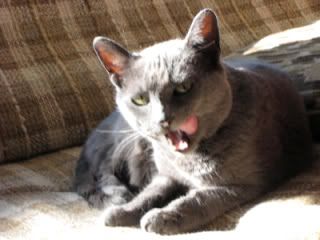
If I were more enthused I would totally smack you.
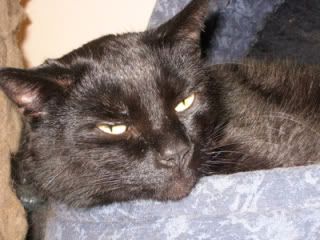
My middle name is reckless abandon.
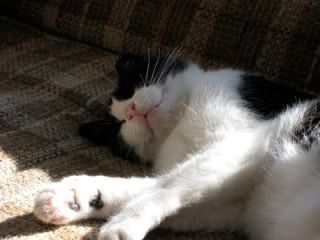
Das da spot, yesssss.
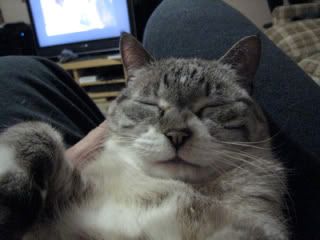

If I were more enthused I would totally smack you.

My middle name is reckless abandon.

Das da spot, yesssss.

Success in Writing
It's actually easy. All you have to do is be very good, work very very hard, get very very very lucky, and survive in the business long enough for people to notice. What could be simpler?
And, yes, I did eat my snarky flakes this morning. Why do you ask?
And, yes, I did eat my snarky flakes this morning. Why do you ask?
Wednesday, February 17, 2010
Newbie Question #20
20. What is the hardest part of writing for you? The easiest?
Sometimes the hardest part for me is the actual sitting down to write bit. But, after I've conquered the sheer discipline of making time and space in my life to write, I find plot the hardest.
This is one of those reasons why I tell my students to have some kind of plan before they write -- that's MY problem. If I don't have a plan/plot outline, I would very happily have my characters meander through a sort of endless soap opera. There would be a lot of drama, but no real movement forward, you know?
As I said at a talk I did at the public library on Sunday, I'm pretty good at dividing threads of plot, complicating things, making my character face hardships that require them to consider "what's at stake?" -- but I have a harder time pulling bits back together and tying up all the story lines. If I don't pre-think those aspects of plot, I can get really tangled up.
The easiest part is characters. I'm one of those people who have always shared a large percentage of my brain with imaginary friends. When it was socially acceptable to do so, I roped my friends into playing complicated games with superheroes (and their Barbies) and other kinds of pretend. When it became awkward to ask people to romp in the woods pretending to be knights and princesses, I started keeping those people in my head. There's only so much room in my brain, so they quickly dribbled out onto notebook paper. This is all that practice writing I talked about, but which I sometimes still do as I'm falling asleep at night.
Almost all of my characters have lived in my head for some time (some for years -- I had Sebastian since high school) before they appear on page. I think this is why I sometimes get the comment that my characters seem very three dimensional. They have an entire life already lived before they even become text in a book.
This is one of those questions that's different for everyone. I'd love to hear from other people. What about y'all?
Tuesday, February 16, 2010
The Future Gets a Fresh New Look
 Good morning, Wyrdsmiths readers! You'll notice a new look to the blog today; our Internet elves were up late last night, putting on a fresh coat of paint, and things are starting to look downright shipshape around here. Besides a little sprucing up, one important reason for our upgrade is to help combat the inundation of comment spam we've been experiencing lately, to which end we've activated Blogger's word verification feature for anonymous commenters. Other than that, your experience here should be much the same; everything is where it's always been: 1,427 posts since August 2006 and still going strong. Enjoy.
Monday, February 15, 2010
Smart Things
Pat Rothfuss saying smart things about how much easier it is to become a writer if you live someplace cheap. Tobias Buckell concurs. All I can add is: true dat.
Jay Lake saying smart things about listening to writing advice from pros. Or, just because it worked for us doesn't mean it will work for you.
Sharon Lee with a breakdown of writing income and writer finances. Or, it's not a great way to get rich. Seanan McGuire with more on the same topic.
And, just to get this out of my browser, Neil Gaiman, with something cool on American Gods and the House on the Rock. I might actually have to see if I can go to this. The House on the Rock is all kinds of weird.
Jay Lake saying smart things about listening to writing advice from pros. Or, just because it worked for us doesn't mean it will work for you.
Sharon Lee with a breakdown of writing income and writer finances. Or, it's not a great way to get rich. Seanan McGuire with more on the same topic.
And, just to get this out of my browser, Neil Gaiman, with something cool on American Gods and the House on the Rock. I might actually have to see if I can go to this. The House on the Rock is all kinds of weird.
Friday, February 12, 2010
Friday Cat Blogging-Reruns Edition
Some older pics:
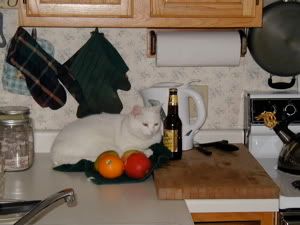
Still Life With Beer
Yin-Yang-Yeow?
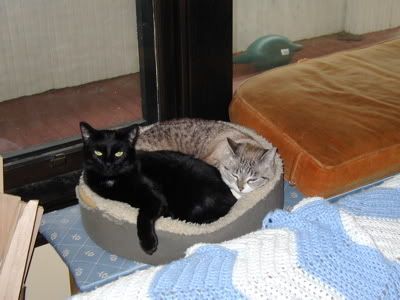
Dis my Lounger!
Shh, I is hovering.
Still Life With Beer

Yin-Yang-Yeow?

Dis my Lounger!

Shh, I is hovering.

Wednesday, February 10, 2010
Writing as Process/Writing as Artifact
Lonfiction asked a question about whether or not you might regret anything you'd written if you knew that nothing you wrote would ever be published going forward. It made me realize that things I have written and things I'm writing are completely different animals for me. It's really worthwhile to go read the whole thread as there are some very interesting conversations there. Here is my response:
It's an interesting thought experiment, but one that strips gears for me, because at some fundamental level writing forward and past writing are unrelated creatures for me.
I write what I'm writing now because I fall in love with the story and in love with the writing of it. I do write it with the intent to sell it but that's only so that I can afford to fall in love with the next story.
Once it's written, unless I'm doing sequels of some sort, it becomes an artifact to be sold or (sometimes) parked and is no longer really "writing" for me until I engage with it again, either because I've fallen in love with some changes to the story, or because someone has bought it and I'm getting paid to revise.
So, going forward, writing is process, looking back, writing is an artifact. For me, regretting the artifact would be like regretting a couch…in storage…that costs me nothing to store…and that I never see. Until, that is, someone comes along and offers to buy it if only I'll reupholster it, or until I think, hey that couch would be so much cooler with some throw pillows. Then it becomes process again.
It's an interesting thought experiment, but one that strips gears for me, because at some fundamental level writing forward and past writing are unrelated creatures for me.
I write what I'm writing now because I fall in love with the story and in love with the writing of it. I do write it with the intent to sell it but that's only so that I can afford to fall in love with the next story.
Once it's written, unless I'm doing sequels of some sort, it becomes an artifact to be sold or (sometimes) parked and is no longer really "writing" for me until I engage with it again, either because I've fallen in love with some changes to the story, or because someone has bought it and I'm getting paid to revise.
So, going forward, writing is process, looking back, writing is an artifact. For me, regretting the artifact would be like regretting a couch…in storage…that costs me nothing to store…and that I never see. Until, that is, someone comes along and offers to buy it if only I'll reupholster it, or until I think, hey that couch would be so much cooler with some throw pillows. Then it becomes process again.
Tuesday, February 09, 2010
Newbie Question #16
16. Have you ever doubted yourself while writing? If so, how do you get over it?
I doubt myself all the time, just ask the folks in my writers' group. I constantly complain that I don't know what the f**k I'm doing or that my stories suck, etc., etc. I get over my doubt by tapping my support network -- my writers' group and my partner. (Because, if nothing else, my partner will say these magic words: "We need the money." Works for me every time. :-)
But I think this is actually a question about writers' block, which is I think a more delicate and harder question to answer.
There are a lot things about this business that can freak people out to the point that they can't write. Most of the really hard ones, IMHO, come after you publish that first book, but there are a few potential killers early on.
One of the reasons I find writers' critique groups of any kind (in-person or on-line) so vital to a writer's career is because they help prepare you for the first and foremost challenge to your ego, and that is: criticism.
People are going to hate your precious babies your entire career. They just are. (I just stumbled across a rather nasty review of Tall, Dark & Dead just today.) But, before you have the cache of a New York publisher's approval, rejection is even harder to take.
If you can't handle criticism or rejection, surviving as a writer is going to particularly difficult. My advice is to find a writers' group and practice taking those slaps in the face and pulling yourself back up on your feet. It's a skill set you're going to use all the damn time.
The other big one you're going to face is rejection. Publishers (and literary agents) are going to turn you down, early and often. It may take several years and dozens of books before you break in. This is why it's important to love what you do. If you like to write, it's easier to pick up your keyboard after you have that big huge weep fest after the sixteenth rejection for your beloved book comes in the mail (when you were SURE this would be the one).
My advice is to practice this attitude: "OMG,I suck; Damn, I'm a genius!" Seriously, I think you have to be a bit unstable to be a good writer. You have to be able to accept that you suck (so you can LISTEN to critique and learn from it), while simultaneously believing you are the best writer who ever lived (so you can get the morning after a crushing critique/rejection and write once again).
The other things that I, personally, found nearly crippling is the stuff that happens after you publish. The first negative review hurts. There will be one and it will feel horrible. You'll believe every word (when, ironically, you didn't believe a word of the praise in the positive reviews.) If you're me, you'll memorize the meanest thing the reviewer wrote and be unable to forget it. Ever. Ask me if we ever meet. I can still give it to you verbatim.
The other thing is what I call "second book-itis" or pysch out. After the adrenaline rush has coursed through your veins after the sale of that first novel, you suddenly realize you're contracted for another book THAT PEOPLE ARE ACTUALLY GOING TO READ. If you're like most authors, you probably lived with that first novel for years before anyone bought it. You had lots of time to massage it and make it the best novel you possibly could. Usually, too, the publisher has contracted you for another book -- either a sequel or something else. Either way, you're sitting down to write that next book (usually before the first one has come out) and, if you're me, you're absolutely frozen by the idea that it could really, really SUCK and kill your career before it's even started.
That one is the hardest one for me. I don't have any good advice except to say that you'll just have to push through. I tend to get over the "OMG people are going to read this" thing (which I often still get) the same way a lot of actors get over stage fright. I lie to myself. I tell myself that no one is going to read the book but me and maybe my editor. I trick myself into believing this by writing most of my book in something other than manuscript format and in a file named something like "New stuff."
I'm sure there are other reasons people get hit with writers' block, but these are the ones I've dealt with. What about the rest of you out there? What freezes your brain?
--------------
* Previous questions have been answered on my Tate Hallaway blog, if you're interested.
Monday, February 08, 2010
No, the publishers are probably not going away tomorrow
I personally adore reading on a screen—when my publisher shifted to an all electronic work flow for editorial I was delighted—and it's certainly very likely that e-books will become a large part of books sold sooner rather than later. At the same time, I don't think that books are going away any time soon and I'm not at all certain that the shift to CD and MP3 is a good comparison to a shift to e-readers.
For one thing, the formats killed off by digital music had much shorter histories and testing periods. The LP lasted what, a bit over 40 years as the primary delivery system for recorded music? Recorded music itself goes back to the 1850s and has had significant format improvements every 20-40 years. The book in codex form goes back to Republican Rome with only minor changes—that's 2,000+ years of optimization.
For another there's the delivery model. Publishers, in one form or another, go back further than the codex (Sosius and Co would be a Republican Roman example).. Record companies? Not so much. It's perfectly possible that digital is going to completely and utterly change all that in a year or five or ten, but everyone said the internet made recessions obsolete too, and look what happened there.
The codex (and many of the big publishers) have survived the advent of talkies, radio, television, the serious audiobook, and (so far) the e-book. The weight of history is currently on the side of publishers and physical books surviving for at least a while longer and e-books only becoming a part of the mix.
Is it possible that physical books will go away completely? Meh, we'll see. Become boutique items only? Probably, but it may well take a lot longer than the digital visionaries expect it to.
Are publishers going away? Almost certainly not. Despite what many people have been saying lately, they serve a lot of valuable purposes in the production of books. Will the current publishers be the publishers of tomorrow. Some of them probably will, some won't. Just as some of the publishers of yesterday are the publishers of today.
For one thing, the formats killed off by digital music had much shorter histories and testing periods. The LP lasted what, a bit over 40 years as the primary delivery system for recorded music? Recorded music itself goes back to the 1850s and has had significant format improvements every 20-40 years. The book in codex form goes back to Republican Rome with only minor changes—that's 2,000+ years of optimization.
For another there's the delivery model. Publishers, in one form or another, go back further than the codex (Sosius and Co would be a Republican Roman example).. Record companies? Not so much. It's perfectly possible that digital is going to completely and utterly change all that in a year or five or ten, but everyone said the internet made recessions obsolete too, and look what happened there.
The codex (and many of the big publishers) have survived the advent of talkies, radio, television, the serious audiobook, and (so far) the e-book. The weight of history is currently on the side of publishers and physical books surviving for at least a while longer and e-books only becoming a part of the mix.
Is it possible that physical books will go away completely? Meh, we'll see. Become boutique items only? Probably, but it may well take a lot longer than the digital visionaries expect it to.
Are publishers going away? Almost certainly not. Despite what many people have been saying lately, they serve a lot of valuable purposes in the production of books. Will the current publishers be the publishers of tomorrow. Some of them probably will, some won't. Just as some of the publishers of yesterday are the publishers of today.
Sunday, February 07, 2010
Smart Things & More Amazonfail
Jay Lake saying smart things About the life cycle of a manuscript going through publication and all the things a publisher does. This is related to the Amazon Macmillan mess, but would be a smart thing even without that. In the future I will direct my writing students to take a look at this post.
Agent Joshua Bilmes talking about e-book royalty structures.
Amazonfail links:
Snerched from Jay Lake, two posts on Apple's entry into ebooks both of which predate Amazonfail and both of which talk about the disruptive effects of the agency model. One, and Two.
Serious smackdown on ebook costs and publishing realities. Some very interesting stuff here.
New Macmillan author Blake Charlton freaking out about Amazonfail in a very way with a very funny post.
Cat Valente on why she doesn't see self-publishing replacing traditional publishing any time soon. Some very good thinking in here, though I'm not sure the cheese thing is the best analogy.
Sean Fodera with a very nice post on publisher overheads. Lots of good discussion in the thread too.
Agent Joshua Bilmes talking about e-book royalty structures.
Amazonfail links:
Snerched from Jay Lake, two posts on Apple's entry into ebooks both of which predate Amazonfail and both of which talk about the disruptive effects of the agency model. One, and Two.
Serious smackdown on ebook costs and publishing realities. Some very interesting stuff here.
New Macmillan author Blake Charlton freaking out about Amazonfail in a very way with a very funny post.
Cat Valente on why she doesn't see self-publishing replacing traditional publishing any time soon. Some very good thinking in here, though I'm not sure the cheese thing is the best analogy.
Sean Fodera with a very nice post on publisher overheads. Lots of good discussion in the thread too.
Saturday, February 06, 2010
Friday Cat Blogging on Saturday Afternoon
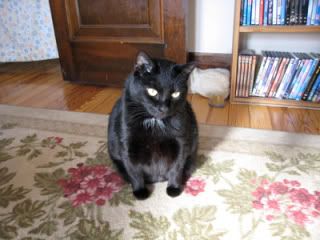
Shade cat.
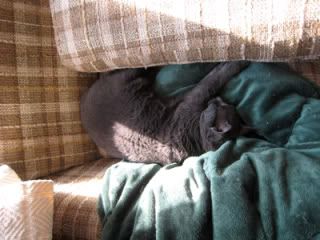
Sun cat
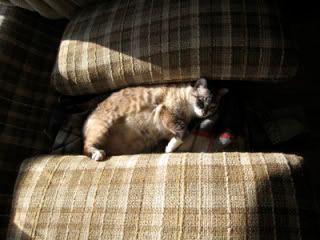
Is this my good side?
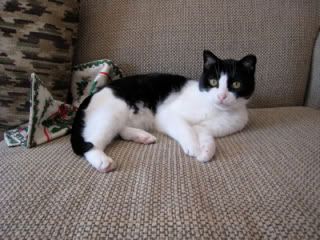
In another life I was a very large toad.

Sun cat

Is this my good side?

In another life I was a very large toad.

In the Absence of Kelly's Cats
Here is one of mine, Ms. All Ball, in her favorite spot on the radiator.


Wednesday, February 03, 2010
No, Really, Publishers Do A LOT For The Author
I wrote the note below in response to someone saying (for the 5,000th wrong time in this Amazon thing) that publishers are no longer necessary because of internet distribution of ebooks. It takes a lot of money to produce a book in terms of editing, copyediting, PR, and even gatekeeping (yes there's value to gatekeeping, it helps readers find books they have much better odds of enjoying). Now, this particular comment was a slightly more sophisticated version of the "you don't need publishers" argument in that it at least acknowledges that those things need to happen and suggests outsourcing. But that's still not a workable model because it ignores the economics of the situation. So let me address that:
Under the current model one of two things happens: 1) I write the book, my publisher buys (the rights), fronts all the other costs, and I get paid so that I can eat while I'm writing the next book—then, assuming I earn out—more money comes in on a regular basis starting between 6 months and several years after publication, allowing me to continue to eat. 2) My publisher buys the book on proposal and I get paid in advance to write it, then they front all the other costs and the rest follows.
If I want to become my own publisher I have to front all those costs myself and have to wait till the book earns out (maybe) to recoup those costs (again maybe) up to several years after I've fronted them. But, since I don't have a spare 5-20k* sitting around that I can bet on a possible return potentially several years down the line, what actually happens is I stop writing and find a new job and there are no more Kelly McCullough books. So, yes, ____ was pretty much all wrong.
And that's without accounting for things that my publisher does that don't go directly into the making and selling of the book, like my publisher's legal department—which I hope never to become any more familiar with than I am now. In a perfect world none of my books will ever get involved in a legal dispute of any kind, but if someone decides to sue me for any reason whatsoever in regards to my writing, the fact that I have a major publisher on my side significantly reduces the chance that a frivolous (or otherwise) lawsuit bankrupts me.
*Updated to add: I should probably also note that 5-20k is what a publisher pays for copyediting etc. and that the price they get based on their volume and reliability is much better than the price I would be likely to get for those same services.
Under the current model one of two things happens: 1) I write the book, my publisher buys (the rights), fronts all the other costs, and I get paid so that I can eat while I'm writing the next book—then, assuming I earn out—more money comes in on a regular basis starting between 6 months and several years after publication, allowing me to continue to eat. 2) My publisher buys the book on proposal and I get paid in advance to write it, then they front all the other costs and the rest follows.
If I want to become my own publisher I have to front all those costs myself and have to wait till the book earns out (maybe) to recoup those costs (again maybe) up to several years after I've fronted them. But, since I don't have a spare 5-20k* sitting around that I can bet on a possible return potentially several years down the line, what actually happens is I stop writing and find a new job and there are no more Kelly McCullough books. So, yes, ____ was pretty much all wrong.
And that's without accounting for things that my publisher does that don't go directly into the making and selling of the book, like my publisher's legal department—which I hope never to become any more familiar with than I am now. In a perfect world none of my books will ever get involved in a legal dispute of any kind, but if someone decides to sue me for any reason whatsoever in regards to my writing, the fact that I have a major publisher on my side significantly reduces the chance that a frivolous (or otherwise) lawsuit bankrupts me.
*Updated to add: I should probably also note that 5-20k is what a publisher pays for copyediting etc. and that the price they get based on their volume and reliability is much better than the price I would be likely to get for those same services.
Linky Bits
My friend Beth being wise about life once again.
Tim Powers annotated bibliography. Want!
Very interesting take on the Amazonfail (Macmillan edition) scuffle by a former music industry exec.
A legal perspective on the same issue by way of how it might impact the Google settlement from C.E. Petit.
Jeff Vandermeer talks about the issue from the point of view of a sense of entitlement.
Tim Powers annotated bibliography. Want!
Very interesting take on the Amazonfail (Macmillan edition) scuffle by a former music industry exec.
A legal perspective on the same issue by way of how it might impact the Google settlement from C.E. Petit.
Jeff Vandermeer talks about the issue from the point of view of a sense of entitlement.
Newbie Questions #11 & 12
11. How do I know which agent is best for me?
12. How much should I expect to pay an agent to represent my book?
Last one first: NOTHING.
Remember the rule that money always flows to the author. A literary agent works the same way a real estate agent does, which is to say that you should pay nothing until the book sells. Then, you can expect to pay a percentage of that sale. When I was agent hunting in the late Cretaceous that percentage was 15%, now-a-days it could be slightly more, but not significantly so. (The exception is foreign sales -- since your agent has to pay sub-agents – but that’s nothing to worry about until a foreign sale happens.)
If your perspective agent charges a reading fee, I say that agent isn’t for you. There may be legitimate reasons why an otherwise reputable agent might charge reading fees, but to me it’s a big red flag that says “run away, run away fast.”
Keep repeating the mantra: money always flows to the author.
As for finding a good agent that fits you, that will be a more personal decision. In the end, you should consider the fact that your agent is your face in the professional arena. After that, it becomes a matter of taste.
For myself, I don’t like agents that edit. Even though my first agent was also a consulting editor, he never asked me to do editorial changes before submitting my work to publishing houses. I like that. It’s my personal feeling that if someone wants me to significantly rewrite a novel, I want to be paid to do so (remember the mantra!)
I also don’t need my agent to be my friend. In fact, I prefer a shark. Someone who I know will go for the best deal possible, even if it means not being terribly nice.
On that note, I do want an agent who is excited about my work. When I was in the process of finding a second agent (the first changed career to be a full-time editor,) I talked to a lot of agents. I had one offer to represent me. It became clear, however, that this agent hadn’t really read my work. Even though it meant being agentless for longer than I would have liked, I told him I wasn’t comfortable having an agent who wasn’t 100% into me. Your agent has to be your go-to guy/gal, your advocate, your nag… someone who e-mails you to say, “what have you got!?” If you’re not on their radar, then it’s easy to be forgotten… and this is your career on the line. You need someone who is going to be with you through good times and bad… because there’s always some bad in this business, I’m sorry to say.
Speaking of being “on the radar,” I think a case can be made for having an agent in New York. I also think that a case can be made that it doesn’t matter one wit. Perhaps the bigger issue is the size of the agency. We all want to have the Big Name Agent (you know the one who wrote the book on writing a bestseller) represent us because just throwing around his name is impressive as hell. However, I’ve had friends get lost among the various cogs in that particular machine. My experience has been that it’s much better to be part of a smallish stable. Ideally, you can end up where I am, which is to have a big name agent in New York who has a relatively smallish, but impressive client list… or at least who never makes me feel less than an A-lister (even if I’m really a C- or D-list writer. And, no, that’s not false modesty. I have no delusions that I’m anything other than a solidly mid-list author.)
You should also find an agent with a track record. It might be great to be someone’s start up client (and I actually know people who have had that work out great for them,) but it’s a safer bet to go with someone established in the business. Because this is a business where it helps to know people who know people… and a completely new agent is less likely to have those connections.
But this is really a matter of taste. There’s nothing wrong with trying to land the biggest name agent (in fact, I always tell students to start at the top and work your way down.) There’s also nothing wrong with having an agent who edits all your work, holds your hand every step of the way, and has an office in Peoria. As long as you are comfortable with the relationship you have and your agent is finding you work, I say do what you will.
My last note is this: don’t hesitate to say no and be picky. It’s tempting to go with the first offer, but you’ve got to believe in yourself. Believe that what you’re doing is worth being paid for, and that this is an important job that not anyone can do. Don’t sell yourself short.
Tuesday, February 02, 2010
What Scalzi Said
John Scalzi is pointing out that in light of the Amazon mess, now would be an excellent time to go out and buy a Macmillan author's book from someplace other than Amazon, because this is going to hurt them. Let me note that is particularly true of authors debuting this week. As an Ace/Penguin author, this doesn't affect me directly, but what Amazon is doing is really bad for publishing in general and writers in specific. Also, a lot of my friends and colleagues are among the collateral damage here.
UPDATED to add: Speaking of which, my friend David Coe has a Macmillan release today, The Horseman's Gambit. He blogs about it here in case you're interested.
UPDATED to add: Speaking of which, my friend David Coe has a Macmillan release today, The Horseman's Gambit. He blogs about it here in case you're interested.
Smart Things
Kris Rusch on professional courtesy.
Kristin Nelson on the iPad and it's coming impact on books and book contracts.
Lilith Saintcrow on righting when you don'wanna!
Fun and funny for word nerds: HapiSofi at Absolute Write on hiring an independent copyeditor—via Teresa Nielsen Hayden Making Light .
Seanan McGuire on what authors do and don't control and in terms of the latest Amazon mess.
Kristin Nelson on the iPad and it's coming impact on books and book contracts.
Lilith Saintcrow on righting when you don'wanna!
Fun and funny for word nerds: HapiSofi at Absolute Write on hiring an independent copyeditor—via Teresa Nielsen Hayden Making Light .
Seanan McGuire on what authors do and don't control and in terms of the latest Amazon mess.
Monday, February 01, 2010
Newbie Question #10
10. How do I go about getting an agent? Where do I look for one?
The first piece of advice I want to give is this: finish your book first!
Now, assuming you've followed the above, finding an agent is an arduous process, but the single most important thing you're going to do as a writer (besides write the best book possible.) There are a few things you can be doing while you're writing your book, and they are --
1) read books you like and keep notes of any names listed in the acknowledgements;
2) subscribe to professional magazines (for science fiction writers, Locus Magazine/ for romance folks, Romantic Times) and check listings to see who is selling what/who. In Locus, you can easily see which agents are selling a lot and a lot of new authors -- make special note of those names; and
3) attend conventions.
In science ficiton, there are plenty of panels where you can go and listen at the feet of actual agents and ask questions about the sorts of books they're selling, etc. In SF/F, however, DO NOT harass any agents or attempt to give "elevator pitches" unless specifically asked. Romance writers have it a little easier. At the romance conventions, you can actually sign up to pitch prospective agents and there are workshops you can attend to teach you how to do so effectively. (Note: you can find a list of conventions in the professional magazines listed above. SF/F writers could attend a convention every weekend, if they had the money and the time. Romance writers, you get a couple of big ones a year -- RT Convention and RWA's convention. Probably there are others, but I have to admit knowing much less about the romance process for finding an agent.)
Once you've got your list of prospective people, I recommend checking out their web pages, if they have them, and see what Predators & Editors has to say about them. If they have a web site, be sure to take note of what kind of package they want sent, whether or not you can simultaneously submit, etc, and FOLLOW THE RULES.
I should say that I found my first agent the old fashioned way... I got a recommendation from a professional writer friend. These are hard to come by because you have to be the sort of person who can effectively schmooze (without oozing) professional authors and get them to lend their name to your cover letter.
The cover letter is probably worth a post of its own, though you can find lots of advice out there. A quick search produced this: writing tips: the cover letter/query. I'm sure there are dozens more out there.
The other piece of advice: come up with strategies to deal with rejection. It's a fact of writing life. Persistence is more important than talent.
Subscribe to:
Posts (Atom)