After a long holiday vacation, I'm staring bleary-eyed at a wretched, wicked Monday.
You?
Seriously, despite a ton on my plate (proposals what need writing and a book what needs copy-editing that just arrived in the e-mail), I've gotten, oh, let's see... NOTHING done so far to day.
I hope the rest of you are faring much better than I am so far.
Monday, November 30, 2009

Sunday, November 29, 2009

Friday, November 27, 2009
Friday Cat Blogging
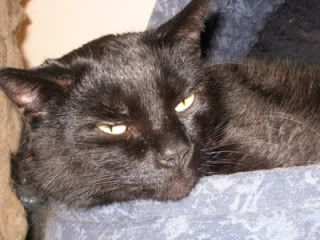
No. I won't look at you. Stop asking.
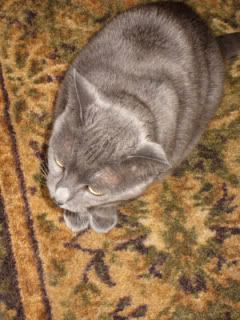
Does this mirror make me look fat?
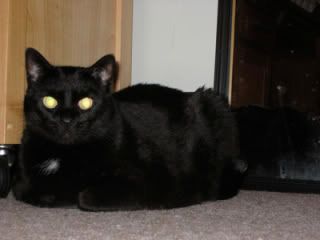
How would you feel about bringing me breakfast in bed?
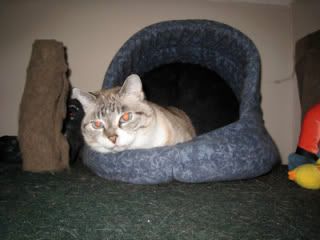
Whazat? Zzzzzz.
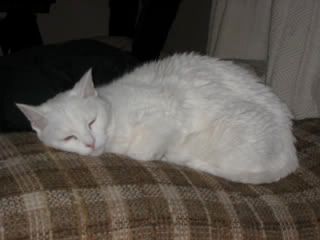
I wuvs you, knee. Do you wuvs me?
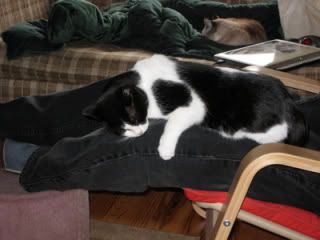

Does this mirror make me look fat?

How would you feel about bringing me breakfast in bed?

Whazat? Zzzzzz.

I wuvs you, knee. Do you wuvs me?

Wednesday, November 25, 2009
Read This While I Write That
I know I'm late on my follow-up to "Storyline vs. Plot" that I posted the other week. I'm very much aware of my tardiness, and I very much apologize for not getting post #2 done. Holiday cooking, deadlines, all that. With luck, I will be able to get my thoughts organized enough to post the second part by the end of the holiday weekend.
In the mean-time, here's a mini-list of some Smart Things:
Nathan Bransford gives a Top 10 list about some of the "myths" people are ascribing to e-books. I haven't exactly figured out where I come down on the fence about the supposed inevitability of e-books, or whether they are good or bad or just plain confusing for authors or publishers or readers (a bit of all three at times, I suspect.) Mr. Bransford has some good points about the benefits of the electric beasties in general; however, I feel obliged to call foul on answer #8 re. e-books and water/sand/travel. His tongue-in-cheek solution aside, if I lose/ruin my paper book in a general sense, I am out somewhere between $7 and $30; if I lose or ruin an e-reader, I'm out a lot more. That isn't an iron-clad argument against them, but giving a one-off solution like his to a very real concern only speaks to one of the more serious questions people have about e-readers that has yet to be adequately addressed.
Tying in to the whole Harlequin brouhaha, Pimp My Novel gives a nice overview of why a person should or should not consider self-publishing their book. And, if you haven't read enough the subject lately, Agent Kristin has more on Harelquin putting their foot in it with regards to agents and other publishers, as well this bit on how an agent is more than just a convenient way to get your manuscript across the transom.
And lastly, we return to Nathan Bransford for a back of the napkin breakdown of the economics of a best-seller. (This is a follow-up on a link Kelly posted last week about Lynn Viehl's royalty statement.) Turns out the money isn't as good on the the other end of the publishing stick as we were initially led to believe, either.
Hope this helps get you through the holiday weekend. Safe travels for those who are going to be out, and a good rest of the week for those readers outside the U.S. who aren't going to be gorging on turkey tomorrow. Do a lap or two around the track for me, will you? I'm sure it'll help the universal karmic balance somehow....
In the mean-time, here's a mini-list of some Smart Things:
Nathan Bransford gives a Top 10 list about some of the "myths" people are ascribing to e-books. I haven't exactly figured out where I come down on the fence about the supposed inevitability of e-books, or whether they are good or bad or just plain confusing for authors or publishers or readers (a bit of all three at times, I suspect.) Mr. Bransford has some good points about the benefits of the electric beasties in general; however, I feel obliged to call foul on answer #8 re. e-books and water/sand/travel. His tongue-in-cheek solution aside, if I lose/ruin my paper book in a general sense, I am out somewhere between $7 and $30; if I lose or ruin an e-reader, I'm out a lot more. That isn't an iron-clad argument against them, but giving a one-off solution like his to a very real concern only speaks to one of the more serious questions people have about e-readers that has yet to be adequately addressed.
Tying in to the whole Harlequin brouhaha, Pimp My Novel gives a nice overview of why a person should or should not consider self-publishing their book. And, if you haven't read enough the subject lately, Agent Kristin has more on Harelquin putting their foot in it with regards to agents and other publishers, as well this bit on how an agent is more than just a convenient way to get your manuscript across the transom.
And lastly, we return to Nathan Bransford for a back of the napkin breakdown of the economics of a best-seller. (This is a follow-up on a link Kelly posted last week about Lynn Viehl's royalty statement.) Turns out the money isn't as good on the the other end of the publishing stick as we were initially led to believe, either.
Hope this helps get you through the holiday weekend. Safe travels for those who are going to be out, and a good rest of the week for those readers outside the U.S. who aren't going to be gorging on turkey tomorrow. Do a lap or two around the track for me, will you? I'm sure it'll help the universal karmic balance somehow....
Tuesday, November 24, 2009
Nothing Important
yet, I just wanted to share....
I'm currently at Adventure Peak letting Mason run off a little steam, because I forced him to sit nicely in the back row at Normandale College while I spoke to a writing class about the life and times of a science fiction writer. I think it's one of the coolest (and also the strangest) perks of being published. Somehow, I've become some kind of expert on writing. It's funny because more often or not at some point when people ask me about some bit of process I end up shrugging and saying, "Huh. I don't really know. Magic?"
Today that was my answer about where my characters come from and "how do you _do_ characterization?" Do it? Dude, it just happens. Characters come out of my head fully-formed, like Athena springing from the head of Zeus.
But, of course, that's not entirely fair... or true. How it gets from your head to the paper is the real question, and the answer deserves some considered thought. I think the answer is probably complicated, but the nugget I was able to pull out of my, er, brain today went something like this: give them a motive, a desire, "motivation," if you will. If every character on the page has something they WANT, it's hard for them not to start to breathe, as it were.
Of course, there's more to it than that, but, in the end, a lot of how it gets actually on to the page is a matter of style. And magic.
The other somewhat unrelated thing I wanted to say is that I gave away a copy of one of my books to every student in the class. I could only give away MESSIAH NODE, because that was the first of my books to go out of print and Shawn and I way over-bought. For a while, I had so many boxes of that particular book, I was sending it by the carton full to romance conventions for giveaways. Now, I'm down to less than one box per title. My tetrology is becoming a scarce commodity. Pretty soon, they really will be collectors items. It's weird to think of, really.
And sort of sad.
It's funny what you expect when you first publish, and, while I understood the business was tough, I somehow always thought it would be longer than this before I watched the last of my books go out the door forever. Funky. Oh, and I just read in Uncle Hugo's Newsletter in the "how's business?" section about Penguin's new return policy, and, believe it or not, it's going to be even harder for new mid-list authors to last in the future.
Damn.
I'm currently at Adventure Peak letting Mason run off a little steam, because I forced him to sit nicely in the back row at Normandale College while I spoke to a writing class about the life and times of a science fiction writer. I think it's one of the coolest (and also the strangest) perks of being published. Somehow, I've become some kind of expert on writing. It's funny because more often or not at some point when people ask me about some bit of process I end up shrugging and saying, "Huh. I don't really know. Magic?"
Today that was my answer about where my characters come from and "how do you _do_ characterization?" Do it? Dude, it just happens. Characters come out of my head fully-formed, like Athena springing from the head of Zeus.
But, of course, that's not entirely fair... or true. How it gets from your head to the paper is the real question, and the answer deserves some considered thought. I think the answer is probably complicated, but the nugget I was able to pull out of my, er, brain today went something like this: give them a motive, a desire, "motivation," if you will. If every character on the page has something they WANT, it's hard for them not to start to breathe, as it were.
Of course, there's more to it than that, but, in the end, a lot of how it gets actually on to the page is a matter of style. And magic.
The other somewhat unrelated thing I wanted to say is that I gave away a copy of one of my books to every student in the class. I could only give away MESSIAH NODE, because that was the first of my books to go out of print and Shawn and I way over-bought. For a while, I had so many boxes of that particular book, I was sending it by the carton full to romance conventions for giveaways. Now, I'm down to less than one box per title. My tetrology is becoming a scarce commodity. Pretty soon, they really will be collectors items. It's weird to think of, really.
And sort of sad.
It's funny what you expect when you first publish, and, while I understood the business was tough, I somehow always thought it would be longer than this before I watched the last of my books go out the door forever. Funky. Oh, and I just read in Uncle Hugo's Newsletter in the "how's business?" section about Penguin's new return policy, and, believe it or not, it's going to be even harder for new mid-list authors to last in the future.
Damn.
Monday, November 23, 2009
More on the Harlequin mess
Snurched from Jay Lake: Seanan Maguire weighs in.
Scalzi. And on a related note Scalzi on self-publishing with a good bit about how to do it and how it's not what Harlequin is doing.
Follow ups from Jackie Kessler: Part two, the day after and Q&A.
Ooh, almost forgot, Small Beer parodies Harlequin's nasty move. Via comments in the Seanan Maguire post above.
Scalzi. And on a related note Scalzi on self-publishing with a good bit about how to do it and how it's not what Harlequin is doing.
Follow ups from Jackie Kessler: Part two, the day after and Q&A.
Ooh, almost forgot, Small Beer parodies Harlequin's nasty move. Via comments in the Seanan Maguire post above.
Saturday, November 21, 2009
Friday Cat Blogging on Saturday
I do so hate these formal portrait sessions.
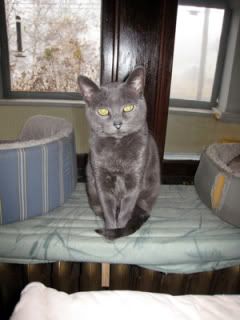
Have I mentioned recently that I despise you?
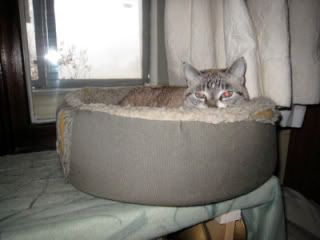
If you'll just hold still I think I can make this jump...
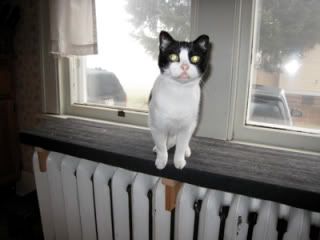
Lady trying to take a bath here.
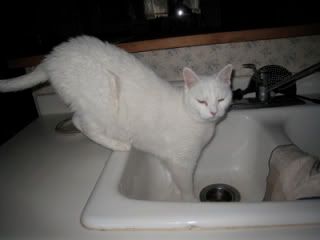
I smell tuna. Is it you?

Have I mentioned recently that I despise you?

If you'll just hold still I think I can make this jump...

Lady trying to take a bath here.

I smell tuna. Is it you?

Thursday, November 19, 2009
RWA Rightly Decertifies Harlequin As A Pro Publisher
The marvelous Jackie Kessler has the scoop. What she said.
Updated:
Add Kristin Nelson's take.
And Making Light.
Ashley Grayson. That one's going to sting.
Updated:
Add Kristin Nelson's take.
And Making Light.
Ashley Grayson. That one's going to sting.
Wednesday, November 18, 2009
Writing Related Link Salad
A bunch of interesting things for writers on the web today.
Via my friend Michael Thomas we have a discussion of the authorial income of one New York Times Best seller. Hint, it's not anywhere near as high as you would hope.
Kristin Nelson is talking about Harlequin's new plan for a self-pubbed line under the heading: Exploitation or Empowerment. I am frankly appalled.
My friend Greg Laden offers tongue in cheek help for writers block with a link to an academic sentence generator.
The Scrivener's Error has a post showing that the Google books settlement version 2.0 doesn't look much better than 1.0. This is a product that never should have come out of beta.
Scott William Carter ask How Online Are You? An author's e-chart of internet engagement. I'm somewhere between a 5 and an 8 (I'm not sure I agree with his designations above five)
Via my friend Michael Thomas we have a discussion of the authorial income of one New York Times Best seller. Hint, it's not anywhere near as high as you would hope.
Kristin Nelson is talking about Harlequin's new plan for a self-pubbed line under the heading: Exploitation or Empowerment. I am frankly appalled.
My friend Greg Laden offers tongue in cheek help for writers block with a link to an academic sentence generator.
The Scrivener's Error has a post showing that the Google books settlement version 2.0 doesn't look much better than 1.0. This is a product that never should have come out of beta.
Scott William Carter ask How Online Are You? An author's e-chart of internet engagement. I'm somewhere between a 5 and an 8 (I'm not sure I agree with his designations above five)
Tuesday, November 17, 2009
Proposals and Series Vs. Standalone pt .1
Part 1: The Blueprint
One of the bigger changes in my mental model of writing over the last five years is that I no longer loathe and fear synopses and proposals. In fact, I have actually come to enjoy writing them. In part this is a function of practice. I've done a lot of these at this point, something on the order of 30, and as with all writing tasks, it gets easier with repetition. But even more, I think it is because I've spent the last five years working in the WebMage world with all its interesting bugs and limitations.
Now, don't get me wrong, I love WebMage and it's been enormous fun to write. At the same time, it's not a story that was originally intended to become a series. In fact, it wasn't even originally intended to become a novel. The process went like this:
It started out as a short story. Then it grew a second (never published) short story. Then those two merged into the first half of the book. Then I wrote a third short that eventually became the opening of book II which grew from there. Then I had to come up with one more rough plot, CodeSpell, and a sketchy idea, MythOS. Then I wrote a series closer that had to incorporate all the earlier stuff and tie it up into a neat package.
This was a lot of fun but it also involved a lot of work in terms of making it all fit together and look like a cohesive whole. Picture a one room cabin that slowly accretes additions until it becomes a small mansion. It can be done in a way that produces something with architectural integrity and style, but it's a hell of a lot more work to do it that way than it would have been to start out by designing a mansion from the blueprints up.
The same is true of series book proposals. In the past five years I've written series proposals for four separate series, two with a complete book attached, two with chapters. In all four cases, I knew from the first moment that I was writing a multi-book saga and was able to put all the story equivalents of pouring the slab, electrical runs, plumbing, and facade into the blueprint ahead of time instead of ripping out and replacing the original inadequate hookups or simply making do.
The end result of that advance planning should be a much more cohesive and seamless whole. In the case of one of the series (a trilogy actually), where I went ahead and wrote book II on spec as well, I was able to see how much simpler it was to get book II written and running with all the foundations waiting for it. It wasn't a perfect fit and there were things in book II that made me go back and make minor adjustments to book I, but overall it was a much simpler and stronger process. The proposal is the blueprint, and if you get that right it means a lot less work and kludging down the road.
But more on that later.
One of the bigger changes in my mental model of writing over the last five years is that I no longer loathe and fear synopses and proposals. In fact, I have actually come to enjoy writing them. In part this is a function of practice. I've done a lot of these at this point, something on the order of 30, and as with all writing tasks, it gets easier with repetition. But even more, I think it is because I've spent the last five years working in the WebMage world with all its interesting bugs and limitations.
Now, don't get me wrong, I love WebMage and it's been enormous fun to write. At the same time, it's not a story that was originally intended to become a series. In fact, it wasn't even originally intended to become a novel. The process went like this:
It started out as a short story. Then it grew a second (never published) short story. Then those two merged into the first half of the book. Then I wrote a third short that eventually became the opening of book II which grew from there. Then I had to come up with one more rough plot, CodeSpell, and a sketchy idea, MythOS. Then I wrote a series closer that had to incorporate all the earlier stuff and tie it up into a neat package.
This was a lot of fun but it also involved a lot of work in terms of making it all fit together and look like a cohesive whole. Picture a one room cabin that slowly accretes additions until it becomes a small mansion. It can be done in a way that produces something with architectural integrity and style, but it's a hell of a lot more work to do it that way than it would have been to start out by designing a mansion from the blueprints up.
The same is true of series book proposals. In the past five years I've written series proposals for four separate series, two with a complete book attached, two with chapters. In all four cases, I knew from the first moment that I was writing a multi-book saga and was able to put all the story equivalents of pouring the slab, electrical runs, plumbing, and facade into the blueprint ahead of time instead of ripping out and replacing the original inadequate hookups or simply making do.
The end result of that advance planning should be a much more cohesive and seamless whole. In the case of one of the series (a trilogy actually), where I went ahead and wrote book II on spec as well, I was able to see how much simpler it was to get book II written and running with all the foundations waiting for it. It wasn't a perfect fit and there were things in book II that made me go back and make minor adjustments to book I, but overall it was a much simpler and stronger process. The proposal is the blueprint, and if you get that right it means a lot less work and kludging down the road.
But more on that later.
Monday, November 16, 2009
Monday morning WIP thread
Manuscriptomancy for me this week with a side order of putting in the last counter. The trunk novel. How about y'all?
Sunday, November 15, 2009
Smart Things
Spent the weekend doing smart things, i.e. laying around the lake place with friends, drinking lightly, eating good food, and crawling into the hot tub in between times. Also, hanging out on the web. From whence, three smart things:
My friend Beth on defining success.
Kristin Nelson on how non-compete clauses are being reworded to prevent you from exercising digital rights if you don't license them to your publisher.
An interesting discussion on Steve Brust's blog about donate buttons and being an artist--most of the action is in the comment thread.
My friend Beth on defining success.
Kristin Nelson on how non-compete clauses are being reworded to prevent you from exercising digital rights if you don't license them to your publisher.
An interesting discussion on Steve Brust's blog about donate buttons and being an artist--most of the action is in the comment thread.
Saturday, November 14, 2009
Cover Art Named "Smith"
Hang around enough writers and you will inevitably hear the topic of book covers come up. How good ones can make you, bad ones can break you, and forgettable ones leave you drifting in the wind. (This isn't an absolute truth by any means, but you will still hear it spoken as if it were.) And, in most cases, it's not something we writers have a whole lot of control over.
I am both looking forward to and dreading my first cover, because I have NO idea what it will look like. My novel is straight-forward fantasy enough that I can see it generating a fairly typical fantasy cover (guys in cloaks with swords peering down alley/around corner, or fighting someone, or sneaking somewhere, or something) but also dark enough that it could generate something really cool (no idea what, but hope springs eternal). But, in either case, all I can do is sit and wait...
Well, that, and read this blog post over on Babel Clash by Annalee Newitz about cliches in book covers, along with a chart breaking down the most commonly recurring elements found in fantasy novel cover art in 2008.
Come on, dragons-weilding-glowing-magic-swords-in-front-of-castles-while-eating-horses!! Woo hoo!
I am both looking forward to and dreading my first cover, because I have NO idea what it will look like. My novel is straight-forward fantasy enough that I can see it generating a fairly typical fantasy cover (guys in cloaks with swords peering down alley/around corner, or fighting someone, or sneaking somewhere, or something) but also dark enough that it could generate something really cool (no idea what, but hope springs eternal). But, in either case, all I can do is sit and wait...
Well, that, and read this blog post over on Babel Clash by Annalee Newitz about cliches in book covers, along with a chart breaking down the most commonly recurring elements found in fantasy novel cover art in 2008.
Come on, dragons-weilding-glowing-magic-swords-in-front-of-castles-while-eating-horses!! Woo hoo!
Friday, November 13, 2009
Friday Cat Blogging
What do you mean I'm on a special food diet?
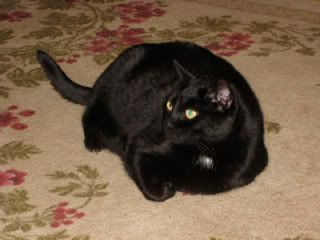
Dude, that was some seriously mellow nip
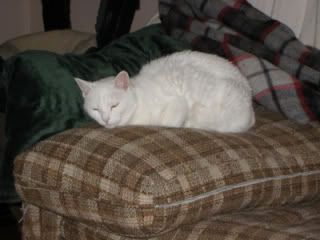
Riiiiiigt...
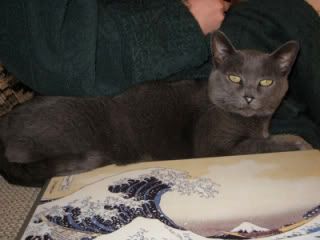
I hearts video games
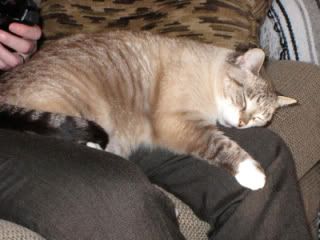
Now, which way is up again?
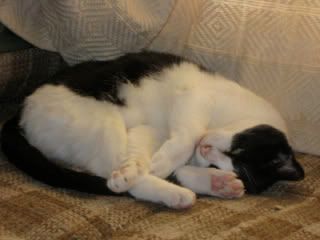

Dude, that was some seriously mellow nip

Riiiiiigt...

I hearts video games

Now, which way is up again?

Wednesday, November 11, 2009
Fast writing and ball dropping
I'm working on a new book proposal, about which more later. My current self-imposed deadline is tomorrow so I can give it to the Wyrdsmiths before I send it off to my agent. The process has me really thinking about writing again for the first time in a while. I'm writing fast at the moment which means that I'm dropping some of the balls I'm juggling. This is not a big deal, as I will pick them up again on the polish pass--as I usually do--but it's very interesting to see which balls are getting lost at this stage. They fall into three main categories:
1) Sentence level stuff. In particular, articles. The faster I write the less I write "the." I think that's my brain not typing bits that can easily be inserted later. updated to add: Also conjunctions. Apparently this post was written fast as I missed at least one above--at least that's what Laura tells me.
2) Smells and other sensory details. As my focus narrows I lose senses, starting with smell. This is a mirror of the real world. I don't have a great sense of smell to start with and on top of that I have the ability/liability to focus on what I'm doing so intensely that a lot of things get sort of grayed out as I'm working intensely on something. It's nice that when I do that I can block out the cat barfing in the hall. It's less so that I block out being hungry, having to go to the bathroom, and at really intense levels, things like my tendons screaming that I need to take a break right now or I'll pay for it later.
3) Character descriptions, and this is the one that really tells me I'm writing up at the edge of what I can do in terms of speed and still remain coherent. I'm a plot and world focused writer and that means that all my character skills are a deliberate effort of craft layered on top of the bedrock stuff. It's a deeply laid skill set at this point, deep enough that I no longer need to think about it at the conscious level much, and I haven't dropped it in years. But yesterday I swapped the gender of one of the minor characters and as I was making the changes I realized I hadn't described them at all because that wasn't an important aspect of the plot function they were originally serving. However, the change will bring them deeper into the story and at that level what they look like becomes important enough that not knowing what they looked like rang bells for me.
Which brings me back to my polish pass comment. At this point in my writing life what I turn in to my editor is very close to what I think of as my first actual draft—the stuff I hand to Wyrdsmiths—after I've read through the rough again and fixed sentences, put in (some*) sensory detail, and done things like describing minor characters. I sometimes forget that there even is a step between putting it on the page and handing it in, because polish typically happens in an hour or two the day before we meet, and I don't have to pay a lot of forebrain attention to it. Despite that it's a critical step and one that probably doesn't get talked about enough by experienced writers.
So, what about you? What do you have to add between rough and first reading? Are there things you habitually have to go back and correct, or is it an ever-changing process?
*There are always more details added after Wyrdsmiths, especially smells, plus larger fixes.
1) Sentence level stuff. In particular, articles. The faster I write the less I write "the." I think that's my brain not typing bits that can easily be inserted later. updated to add: Also conjunctions. Apparently this post was written fast as I missed at least one above--at least that's what Laura tells me.
2) Smells and other sensory details. As my focus narrows I lose senses, starting with smell. This is a mirror of the real world. I don't have a great sense of smell to start with and on top of that I have the ability/liability to focus on what I'm doing so intensely that a lot of things get sort of grayed out as I'm working intensely on something. It's nice that when I do that I can block out the cat barfing in the hall. It's less so that I block out being hungry, having to go to the bathroom, and at really intense levels, things like my tendons screaming that I need to take a break right now or I'll pay for it later.
3) Character descriptions, and this is the one that really tells me I'm writing up at the edge of what I can do in terms of speed and still remain coherent. I'm a plot and world focused writer and that means that all my character skills are a deliberate effort of craft layered on top of the bedrock stuff. It's a deeply laid skill set at this point, deep enough that I no longer need to think about it at the conscious level much, and I haven't dropped it in years. But yesterday I swapped the gender of one of the minor characters and as I was making the changes I realized I hadn't described them at all because that wasn't an important aspect of the plot function they were originally serving. However, the change will bring them deeper into the story and at that level what they look like becomes important enough that not knowing what they looked like rang bells for me.
Which brings me back to my polish pass comment. At this point in my writing life what I turn in to my editor is very close to what I think of as my first actual draft—the stuff I hand to Wyrdsmiths—after I've read through the rough again and fixed sentences, put in (some*) sensory detail, and done things like describing minor characters. I sometimes forget that there even is a step between putting it on the page and handing it in, because polish typically happens in an hour or two the day before we meet, and I don't have to pay a lot of forebrain attention to it. Despite that it's a critical step and one that probably doesn't get talked about enough by experienced writers.
So, what about you? What do you have to add between rough and first reading? Are there things you habitually have to go back and correct, or is it an ever-changing process?
*There are always more details added after Wyrdsmiths, especially smells, plus larger fixes.
Tuesday, November 10, 2009
Smart Things
J Steven York on the value of covers and how that can be lost with ebooks.
Mari Mancusi guest posting at Kristin Nelson's blog: Never give up. Never surrender.
Lilith Saintcrow on how writing (producing art) can save your life. Smart and wise and may I note that what you write can save other's lives as well. I'm pretty sure books saved mine.
Kris Rusch writing about careers and setbacks and how things may not look the same from the inside as they do from the outside. Much here to think about in terms of setting and achieving goals and writer jealousy. She quotes Robert Silverberg: “So my career, marked as it has been by triumph after triumph, has often seemed to me like nothing but a formidable struggle.”
Kristing Nelson on why you should be paying close attention to Google books, especially if you're a writer--you might be missing out on income that should be coming your way.
Mari Mancusi guest posting at Kristin Nelson's blog: Never give up. Never surrender.
Lilith Saintcrow on how writing (producing art) can save your life. Smart and wise and may I note that what you write can save other's lives as well. I'm pretty sure books saved mine.
Kris Rusch writing about careers and setbacks and how things may not look the same from the inside as they do from the outside. Much here to think about in terms of setting and achieving goals and writer jealousy. She quotes Robert Silverberg: “So my career, marked as it has been by triumph after triumph, has often seemed to me like nothing but a formidable struggle.”
Kristing Nelson on why you should be paying close attention to Google books, especially if you're a writer--you might be missing out on income that should be coming your way.
Monday, November 09, 2009
Storyline vs. Plot, part 1
(The following is cross-posted from my LiveJournal.)
A little while back, I made comment about having a storyline for my next book, but not a plot. I have since realized that may be causing some people to scratch their heads as to what the difference is between the two. Then again, maybe no one is wondering. I don't know. But, for the sake of the narrative ploy, let's assume that at least one of the five people who read this blog regularly are, indeed, perplexed, and not merely plagued by dry scalp.
I'll start out by saying that the definition, and therefore the difference, between storyline and plot is going to vary by writer. For some, it is essentially one and the same beastie; for others, there can be a big difference. As for me, well...
When I say storyline, I am talking about the overall arc of the narrative. (In fact, "story arc" would be another way of putting it.) So, when I say I have a storyline, I am saying that I have an idea of not only what the story is going to be about (plot-ish), but also how it is going to unfold over the length of the telling. I know most of the key players, I know what at least a few of them want, I know how what happens will impact them, and I have some idea how it will resolve itself. Mostly. Sort of.
Does this mean I have the fabled Beginning, Middle and End? Not quite: what I have is an idea of what comes first, know a few things that need to happen on the way, and a basic idea where things will end up. I know where the story is going in a general sense, but I don't yet have all the dips and curves in the road mapped out, let alone know all the stops I will need to make on the way.
But -- and this is the important part -- I know what the story is about. Not thematically, but intellectually/creatively. I know that all of the action, all of the plot I develop, all of the victories and defeats I throw at my characters, have to lead towards a couple of specific goals. I know that certain things must happen, and have an idea of the order they must happen in. In short, I know the story -- well enough that, if I had to, I could probably throw together a back of the book teaser for the reader. (Note: I am not saying this teaser would still necessarily be valid by the time I am done with the book. Things change as you plot and write the work itself.)
So how is this different (for me) from plot? Good question, and one I think I will come back to in my next post. :)
A little while back, I made comment about having a storyline for my next book, but not a plot. I have since realized that may be causing some people to scratch their heads as to what the difference is between the two. Then again, maybe no one is wondering. I don't know. But, for the sake of the narrative ploy, let's assume that at least one of the five people who read this blog regularly are, indeed, perplexed, and not merely plagued by dry scalp.
I'll start out by saying that the definition, and therefore the difference, between storyline and plot is going to vary by writer. For some, it is essentially one and the same beastie; for others, there can be a big difference. As for me, well...
When I say storyline, I am talking about the overall arc of the narrative. (In fact, "story arc" would be another way of putting it.) So, when I say I have a storyline, I am saying that I have an idea of not only what the story is going to be about (plot-ish), but also how it is going to unfold over the length of the telling. I know most of the key players, I know what at least a few of them want, I know how what happens will impact them, and I have some idea how it will resolve itself. Mostly. Sort of.
Does this mean I have the fabled Beginning, Middle and End? Not quite: what I have is an idea of what comes first, know a few things that need to happen on the way, and a basic idea where things will end up. I know where the story is going in a general sense, but I don't yet have all the dips and curves in the road mapped out, let alone know all the stops I will need to make on the way.
But -- and this is the important part -- I know what the story is about. Not thematically, but intellectually/creatively. I know that all of the action, all of the plot I develop, all of the victories and defeats I throw at my characters, have to lead towards a couple of specific goals. I know that certain things must happen, and have an idea of the order they must happen in. In short, I know the story -- well enough that, if I had to, I could probably throw together a back of the book teaser for the reader. (Note: I am not saying this teaser would still necessarily be valid by the time I am done with the book. Things change as you plot and write the work itself.)
So how is this different (for me) from plot? Good question, and one I think I will come back to in my next post. :)
The Adventures of Lil' Cthulhu
I feel very strongly that everyone needs to watch this. Via Kelly on Facebook, via Doug.
Friday, November 06, 2009
Friday Cat Blogging
That cat-carrier's not here for moi, is it?
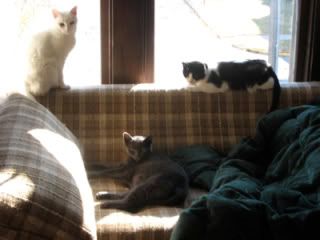
Groovy napping here
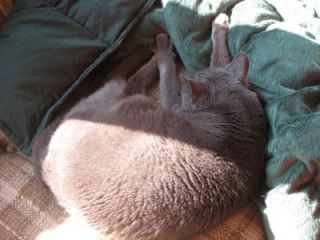
Nothing this cute should ever have to go to the vet
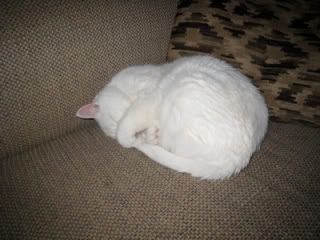
For Meglet it's always casual day
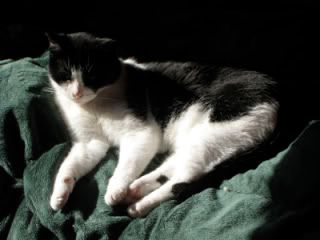
I don't think I should have eaten the whole turkey
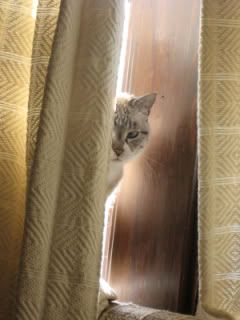
Is my inner beauty shining through again? Sorry if I blinded you.

Groovy napping here

Nothing this cute should ever have to go to the vet

For Meglet it's always casual day

I don't think I should have eaten the whole turkey

Is my inner beauty shining through again? Sorry if I blinded you.

Wednesday, November 04, 2009
The Future is Not Now
I'm back to writing science fiction, and yesterday I wrote a scene in which our hero completely botches a rescue to the point of the whole thing becoming physical comedy. I find myself wanting him, in his sarcastic internal dialogue, say, "Willy E. Coyote to the rescue!"
There are so many reasons why I can't.
The biggest is the most obvious. This is the future. My son only knows about Willy E. Coyote because he's been watching the DVDs of the Warner Brothers cartoons via Netflix (which he finds hilarious, btw.) There's no reason, however, to assume that these cartoons will be consumed by the generation after him or the generation after that.
This is one of the reasons I write urban fantasy at the speed of thought, but it takes me forever to write science fiction. The "Willy E. Coyote" line would have been a gimme in a Garnet book. I either have to abandon it entirely or come up with some alternative that runs the risk of being a "smeerp."* And, being me, because I can't use it, I stare at the screen for at least four minutes mourning the opportunity for easy humor, and then go write a blog about the whole thing.
All I have to say is that the future is not now.
-----
"To call a rabbit a smeerp" from the Turkey City Lexicon
There are so many reasons why I can't.
The biggest is the most obvious. This is the future. My son only knows about Willy E. Coyote because he's been watching the DVDs of the Warner Brothers cartoons via Netflix (which he finds hilarious, btw.) There's no reason, however, to assume that these cartoons will be consumed by the generation after him or the generation after that.
This is one of the reasons I write urban fantasy at the speed of thought, but it takes me forever to write science fiction. The "Willy E. Coyote" line would have been a gimme in a Garnet book. I either have to abandon it entirely or come up with some alternative that runs the risk of being a "smeerp."* And, being me, because I can't use it, I stare at the screen for at least four minutes mourning the opportunity for easy humor, and then go write a blog about the whole thing.
All I have to say is that the future is not now.
-----
"To call a rabbit a smeerp" from the Turkey City Lexicon
Monday, November 02, 2009
Smart Things
My friend Pat Rothfuss: Everyone Hates Their Job Sometimes.
Kate Astres posts: The Unpublished Author’s Guide to Convention Schmoozing. I am not in total agreement with this post, but it's mostly good advice and it's also funny.
Kristin Nelson on Macmillan's new move to pay authors less for e-rights. And why that might not be the best idea they've ever had.
Speaking of contract grabs, how about this language: "edited, in all media, throughout the universe, in perpetuity." from America's got talent, via the the Wall Street Journal.
John Scalzi on Amazon's new dumb idea for digital rights protection. This one's a doozy and would simultaneously violate copyright, most contracts, and really really piss authors off.
Elizabeth Bear on common pitfalls for new authors.
Kate Astres posts: The Unpublished Author’s Guide to Convention Schmoozing. I am not in total agreement with this post, but it's mostly good advice and it's also funny.
Kristin Nelson on Macmillan's new move to pay authors less for e-rights. And why that might not be the best idea they've ever had.
Speaking of contract grabs, how about this language: "edited, in all media, throughout the universe, in perpetuity." from America's got talent, via the the Wall Street Journal.
John Scalzi on Amazon's new dumb idea for digital rights protection. This one's a doozy and would simultaneously violate copyright, most contracts, and really really piss authors off.
Elizabeth Bear on common pitfalls for new authors.
Monday morning WIP thread
I'm home for a while after being gone for 3 weeks of October. I've got a proposal that needs writing, a trunk novel to finish resurrecting, a sink and countertop to install and blogging to catch up with. Friday cat blogging for example as well as trip blogging and car blogging to do, plus maybe even a little writing blogging, oh and smart things so I can close a bunch of tabs. How about y'all?
Sunday, November 01, 2009
Note to Editor
"Would you convey my compliments to the purist who reads your proofs and tell him or her that I write in a sort of broken-down patois which is something like the way a Swiss waiter talks, and that when I split an infinitive, God damn it, I split it so it will stay split."
—Raymond Chandler
—Raymond Chandler
Subscribe to:
Posts (Atom)