So, no imagined dialog this time (sorry, I have other work to do). But for those of you interested in the latest in the Amazon-MacMillan skirmish, I give you the following:
Charles Stross with his break-down of what Amazon and MacMillan were trying to accomplish, respectively. I tend to lean in Charles's direction on this one, but opinions clearly vary if you check out the comments.
Tobias Buckell's many thoughts on what is happening, and why he will no longer be selling his books on Amazon. He gives a nice breakdown of the costs behind what it takes to produce a book, which helps debunk some of the "But the price-point on an e-book is Zero, so I should get them for dirt cheap!" camp's arguments.
Laura Ann Gilman has apparently culled Amazon's (testy?) response to MacMillan's letter and proposal. Love the snarky interspersed comments from her, btw. :)
Want to know more about what's at the root of all this? Fashionista gives an explanation of the agency model that is one of the key issues at the center of this disagreement. ETA: She also gives a nice summary of why, while it may look like Amazon is the good guy for trying to hold the $9.99 e-book line, in the long run a lot of people would lose on the e-book pricing front (except for Amazon, that is).
I have to say that while neither MacMillan nor Amazon are operating out of any sense of altruism here, I am more dubious of Amazon's actions. I worry about any one company that covers so much of the on-line sales and distribution pipe also being the one with proprietary control of the format of ebook distribution as well. Far happier for all of us, I think, if we prmote competition and, in a shiny future, see a common e-format to allow people to read their contents on the device of their choice. May not get there, but I am happier in this instance if the ball lands in MacMillan's court than I am with it in Amazon's.
Also, I just have to say: MacMillan at least put out a professional, adult letter on the matter; but Amazon? Jeez, someone get those kids a balloon and an ice cream before they really have a fit.
Sunday, January 31, 2010

Saturday, January 30, 2010
More from the e-book trenches
(Note: The following is a cross-post from my LJ, and expresses my opinions. It is not meant to reflect the opinions of the Wyrdsmiths in any way. I post it here primarily for it's informative content re. Amazon's action on Friday.)
From the "This Just In" Dept.:
According to Jim Hines, among others including John Scalzi, Jay Lake and....well, I'm sure you can Google it all yourself), the entirety of MacMillan publishing's books (including SF/F imprint Tor) was pulled from Amazon on Friday. The, as of my reading, single anonymous source cited re. motives states that:
...the disappearance is the result of a disagreement between Amazon.com and book publishers that has been brewing for the last year. Macmillan, like other publishers, has asked Amazon to raise the price of electronic books from $9.99 to around $15. Amazon is expressing its strong disagreement by temporarily removing Macmillan books, said this person, who did not want to be quoted by name because of the sensitivity of the matter.
Clearly, this is a business dispute among giants, and falls mainly along economic lines (the following conversation is entirely hypothetical and possibly more mature than any real corporate conversation that occurred):
MacMillan: "Hey, we want you to sell our books for more money so we can make a better profit."
Amazon: "Um, no. We have to sell Kindles because we have our ass into them financially and publically. We need to keep the prices low so people will buy our reader."
Mac: "Yeah, but Apple just said they'd let us set our own pricing in their new iBook store."
Amazon: "Yeah, we saw that. That's why we're busy panicking over here. Get it?"
Mac: "But we've been taking it on the chin. Everyone says our industry is dying. Can't you help a brother out here?"
Amazon: "What part of 'panic' don't you understand?"
Mac: "Dude, we have more experience with panic in our little finger than you've had in your entire body. Panic which you've helped bring around, btw, Mr. 'Who needs a paper book when you can have super-shiny-Kindle-crack'?"
Amazon" "Well, bite me."
Mac: "Asshole."
Amazon: "Dick."
Mac: "Loser"
Amazon: "Dweeb."
Mac: "The iPad is like 10 times cooler than your dick-head Kindle anyhow."
Amazon: "That's it! Your books are SO toast!"
Mac: "Baby!"
Amazon: "Whiner!"
...and so on...
In the end, though, I think both Skalzi and Lake have points when they say that this dust-up does nothing to help either the writers or readers who are on standing at the short end of this stick. Pulling titles, while is sends a message to the publisher, also hurts the readers and writers, as well as sending consumers to other, alternate sites, no matter what the motive. The is the kind of publicity that could come back to bite Amazon in the nether-regions; but it could also be a tempest in a teapot, given their already large market share as well as many people's proclivity to favor price and convenience over taking a stand on something like this. The big questions for me on this is not what Amazon will end up doing once word gets around, but whether or not MacMillan and consumers will blink before Amazon makes their next move.
Update: MacMillan CEO John Sargent has published an open letter over at Publisher's Lunch on the matter from his company's POV. It being a weekend, no news from Amazon yet.
From the "This Just In" Dept.:
According to Jim Hines, among others including John Scalzi, Jay Lake and....well, I'm sure you can Google it all yourself), the entirety of MacMillan publishing's books (including SF/F imprint Tor) was pulled from Amazon on Friday. The, as of my reading, single anonymous source cited re. motives states that:
...the disappearance is the result of a disagreement between Amazon.com and book publishers that has been brewing for the last year. Macmillan, like other publishers, has asked Amazon to raise the price of electronic books from $9.99 to around $15. Amazon is expressing its strong disagreement by temporarily removing Macmillan books, said this person, who did not want to be quoted by name because of the sensitivity of the matter.
Clearly, this is a business dispute among giants, and falls mainly along economic lines (the following conversation is entirely hypothetical and possibly more mature than any real corporate conversation that occurred):
MacMillan: "Hey, we want you to sell our books for more money so we can make a better profit."
Amazon: "Um, no. We have to sell Kindles because we have our ass into them financially and publically. We need to keep the prices low so people will buy our reader."
Mac: "Yeah, but Apple just said they'd let us set our own pricing in their new iBook store."
Amazon: "Yeah, we saw that. That's why we're busy panicking over here. Get it?"
Mac: "But we've been taking it on the chin. Everyone says our industry is dying. Can't you help a brother out here?"
Amazon: "What part of 'panic' don't you understand?"
Mac: "Dude, we have more experience with panic in our little finger than you've had in your entire body. Panic which you've helped bring around, btw, Mr. 'Who needs a paper book when you can have super-shiny-Kindle-crack'?"
Amazon" "Well, bite me."
Mac: "Asshole."
Amazon: "Dick."
Mac: "Loser"
Amazon: "Dweeb."
Mac: "The iPad is like 10 times cooler than your dick-head Kindle anyhow."
Amazon: "That's it! Your books are SO toast!"
Mac: "Baby!"
Amazon: "Whiner!"
...and so on...
In the end, though, I think both Skalzi and Lake have points when they say that this dust-up does nothing to help either the writers or readers who are on standing at the short end of this stick. Pulling titles, while is sends a message to the publisher, also hurts the readers and writers, as well as sending consumers to other, alternate sites, no matter what the motive. The is the kind of publicity that could come back to bite Amazon in the nether-regions; but it could also be a tempest in a teapot, given their already large market share as well as many people's proclivity to favor price and convenience over taking a stand on something like this. The big questions for me on this is not what Amazon will end up doing once word gets around, but whether or not MacMillan and consumers will blink before Amazon makes their next move.
Update: MacMillan CEO John Sargent has published an open letter over at Publisher's Lunch on the matter from his company's POV. It being a weekend, no news from Amazon yet.
Friday, January 29, 2010
Friday Cat Blogging
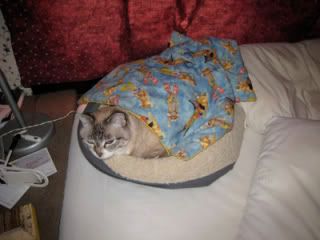
Why yes, I do have my own blanket, why do you ask?
Radiator cats=happy cats.
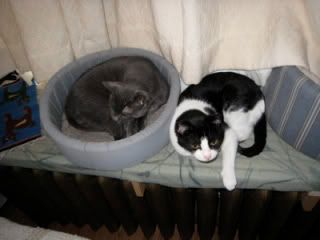
Did you want something? I'm happy here but, for you, anything!
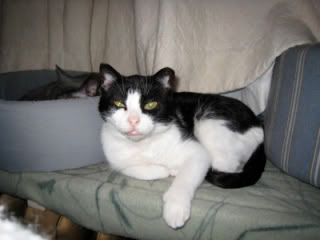
Yes, I do need a whole radiator to myself! I am that fat.
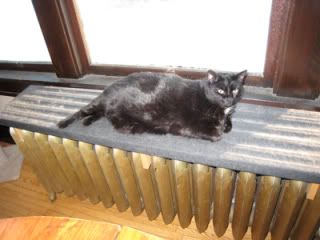

Radiator cats=happy cats.

Did you want something? I'm happy here but, for you, anything!

Yes, I do need a whole radiator to myself! I am that fat.

Thursday, January 28, 2010
Smart Things
Justine Larbalestier and Sarah Rees Brennan saying interesting things about process. SRB's side of the conversation could practically be me.
Kris Rusch saying smart things about coping with feelings of professional jealousy, both your own, and that directed at you.
Kevin J Anderson talks about his experience reading slush.
Deanna Hoak talks about healthy eating and the home alone desk job.
Interesting news from the world of the Kindle, new 70% percent royalty rate epub.
Kris Rusch saying smart things about coping with feelings of professional jealousy, both your own, and that directed at you.
Kevin J Anderson talks about his experience reading slush.
Deanna Hoak talks about healthy eating and the home alone desk job.
Interesting news from the world of the Kindle, new 70% percent royalty rate epub.
Newbie Question #9
9. How do you decide on a title for your book?
Titles are funny things. My first agent told me, “Don’t get attached to the title you picked.” My first agent had a famous client who recognized that he just wasn’t any good at titles and sent each of his novels in to his publisher named “n1”, “n2,” etc. (“n” being “novel.”)
Yet, with three notable exceptions, I’ve always ended up with the title I picked.
Again, I’m mostly working off anecdotal information, but my sense is that first novels often get re-titled. It’s hard to think like a publicity/marketing committee, and that’s who ends up approving the title. The original title for my alter-ego’s debut science fiction novel about angels was, “Dancing on the Head of a Pin.” It was sort of clever, but as my editor pointed out – if I wanted my name to appear on the spine of the book, it had to be shorter. Good motivation!
The marketing department came up with some alternative titles to consider, but I felt that they, well, sounded too marketing department-esque (no offense to marketing committees anywhere!) So, I begged my editor for forty-eight hours to come up with something snappier. I asked my friends who had read the book. I asked my partner for help. I got some great suggestions, but in the end I went with my partner’s suggestion: “Archangel Protocol.”
The way Shawn came up with the title was simple. She’s naturally a list-maker, so she sat down with a pen and paper and made one column of words related to angels. The second column had computer terms. Anything she could think of. Then she started putting them together until she got one that fit. This worked beautifully for the entire series: “Fallen Host,” “Messiah Node,” “Apocalypse Array,” and, the one I’m currently working on, “Resurrection Code.”
This method worked less well for my romances because we were saddled with two problems – the marketing folks really wanted the word “dead” to appear in every subsequent title and for it to be sort of a twist on a familiar cliché, like “Tall, Dark & Dead.” (Which, incidentally, I just came up with on my own by looking through a common phrase book for ideas, and then I did the all important Google search to see how many other books already had that title. I found one from 1958 and thought it would be okay to use again after all that time.) When we got stuck, I polled my FB friends; I posted a request for help here and on my other blogs. One of my favorite titles, “Dead If I Do” came from my friend Susan Harris’s response to a LJ plea.
I ended up having to change two of my Tate titles. The first one was “Dead Sexy,” which I’d originally called “Drop-Dead Gorgeous,” which you probably recognize as a recent MaryJanice Davidson title. I was two thirds the way through writing that book when I happened to read a recent releases column in Romantic Titles, which sent me into a scramble to re-title.
The second time, I was simply out-voted by the marketing folks. I’d initially wanted “Romancing the Dead” to be “Dead on Arousal” (my friend Sean M. Murphy’s most-AWESOME suggestion.) In the end, I think people thought the original was maybe a bit too provocative/sexy… who knows?
I think that having a good title to start with can be a good thing, but, obviously, it’s not necessary in order to sell. I tell title stories in classes I teach on writing, because I think it’s important to remember when you’re first starting out not to “sweat the small stuff.” You could waste a lot of time tweaking a perfect title only to have the marketing department tell you it’s a no-go.
It’s much, much more important to write a good, strong book. And remember: zen and the art of novel writing -- you’re responsible for the stuff between the covers. Make it the best you can, and let go of the rest.
Wednesday, January 27, 2010
Newbie Question #8
8. How do you decide how long a book should be?
I stop when I get to the end of the story.
But I suspect this is actually a question about industry standards, so here's what they are, according to the Nebula Awards:
Novel: a work of 40,000 words or more*
Novella: a work of at least 17,500 words but under 40,000 words
Novelette: a work of at least 7,500 words but under 17,500 words
Short story: a work of under 7,500 words
I should note that for anyone other than the Nebula judges 40,000 words is actually a really, really short novel. I don't think many publishers would accept a novel that was only 40,000 words -- though readers of this blog should feel free to prove me wrong.
My sense is that the average novel length these days (which, during the course my career to-date, has actually grown a lot shorter) is 80,000 words or longer (with the exception of young adult novels which can be as short as 60,000.)
I know that a lot of newbie writers have a hard time visualizing how many pages 80,000 words is -- but you can pick up any of my Tate Hallaway books and see how it translates into a printed book. A manuscript will, if you follow manuscript format, be a lot longer.
Questions? Comments? Spam?
Tuesday, January 26, 2010
Newbie Question #7
7. How do you set up your books? Do you outline them first or do you have an idea and just go with it?
That question has changed for me as my career has advanced, and, in some rare cases, on a book by book basis. So my initial answer is, "Yes. Both. All. None."
Before I go into an explanation of that, I will tell you that I'm a big fan of "pre-thinking," however you might choose to do that. It's my anecdotal experience that successful writers "pre-think" on some level. For some, this means a detailed synopsis/outline. I know of another writer who writes out idea trees/notes on butcher paper stuck to his walls. I've been to workshops that promote an organic brainstorming system.
I think all these methods have varying degrees of usefulness for me. There are some I personally resist: note cards (I lose them), strict outlines (I abandon them with glee.) BUT, just because they don't work for me, doesn't mean they won't work for you.
However you choose to organize your thoughts, I think it's incredibly helpful (particularly for a new writer) to have a pretty good idea of where your story is going before you write it. A dear friend and mentor, Joan Vinge likens her process to a road trip. She says she might not even know who is coming with her (characters), but she's planning to go from New York to California (just to stretch the metaphor a bit.) All sorts of unexpected things might happen along the way, but as long as she keeps her destination in mind, she can keep going forward. The story may end before they get to their metaphorical California, but the idea of going there has kept the story on track. For someone like me who is very organic in my thinking and process, I loved this idea because it freed me from the restriction of a rigid outline, but allowed me to consider the bones of my story and where I wanted to go with it BEFORE I STARTED.
I know, too, that a big concern for a lot of new writers is the idea of writing themselves into a corner. First of all, it has always been my contention there is no corner so tight that an author can't break a wall to get their characters out... but I also understand that the root of the fear is based on worrying that you'll get stalled because you don't know where to go with a certain plot line. "Pre-thinking" helps. If you have a note card, note book, scribbles, a diagram, an outline to go back and refer to, you less likely to get stuck.
Anything that keeps the story moving and the writer writing is a good, good thing.
But, back to your original question. These days I outline. Most of the books I write are sold on proposal. The proposal is a detailed (usually for me about 12 pages) synopsis that tells the beginning, middle and end and hits the emotional highlights for the main characters. What's left out is the subplots (and the surprises, because, with me, there are always some.)
However, I'm also writing a novel for a small press right now where, as I told my writer friend Naomi Kritzer, I'm writing without a net. I have no idea where the story is going.... and it's working. It's the kind of novel, however, that I have to mentally work overtime on. Literally. I dream about it. When I'm working out, ideas hit me. It's a very different (and much messier) process than I've gotten used to. But it tells me something, too. The just running with the idea method works for me for this book. So it might work for you.
I will leave you with this thought, though. I often encourage my students to try some method of pre-thinking because, let's face it, new writers have a lot of challenges to face. These questions you ask are just the surface of them. So, if you have an ace up your sleeve of a solid storyline that you know has a beginning, middle, and end, that's one less thing to worry about, you know?
Just a thought, Mr. Fox.
Monday, January 25, 2010
Smart Things
Dean Wesley Smith on agents. I don't always agree with everything Dean says but there are few people in the business who know more about its in and outs. My disagreements with Dean come in part because I think that he's far enough away from entering the field that some things that are true for Dean are not true for people just coming in now—hell, that's true for me as well. Some things have changed in interesting ways just in the few years I've been here.
Lilith Saintcrow on editors as allies. Really, your editor is on your side. Oh, and also, acting like what you want to become, in this case, a professional writer.
Snerched from Jay Lake, Paul M Jessup on how to filter advice on writing.
My friend Beth on the part day-dreams play.
Justine Larbalestier on book covers.
Jo Walton on reading SF.
Lilith Saintcrow on editors as allies. Really, your editor is on your side. Oh, and also, acting like what you want to become, in this case, a professional writer.
Snerched from Jay Lake, Paul M Jessup on how to filter advice on writing.
My friend Beth on the part day-dreams play.
Justine Larbalestier on book covers.
Jo Walton on reading SF.
Saturday, January 23, 2010
Newbie Question #6
6. How do you, when writing dialogue, make sure that each character sounds like a unique person?
Start with distinct, unique characters.
One thing I'm probably going to end up saying over and over during the course of this series is that conflict = drama. My suspicion is that if you're getting the critique that your characters all sound the same it's because they're difficult to tell apart for other reasons as well. They all come from the same socio-economic class. They're all the same ethnicity/race/(or in the case of science fiction/urban fantasy) species. They have the same agenda/goals. In other words, they have too much in common.
Romances are rarely exciting (to me, at least,) if a lady is marrying a lord she's perfectly suitable for. Better, IMHO, that she's totally smitten by the gardener/slave-gladiator/space pirate/rogue, etc. who is not only so WRONG for her (on the surface, of course), but completely outside of her expected socio-economic pairing.
If you've got a high class princess and a slave-gladiator in the same room talking to each other and they sound the same, then, I'm sorry to say: you're just not thinking.
The slave-gladiator isn't going to use fifteen dollar words, because he likely wasn't educated (if he was, your princess ought to be shocked and there better be a fascinating reason for it). Even if he was once a great lord/general/etc., his life now will probably be rougher and his language ought to show it. More swear words (or their equivalent). Less philosophical debate, more show me the money, as it were.
And, honestly, that's one of the easiest "tricks" (if you really need one). Make your heroine a space commander who uses crisp, militaristic sparse sentences. "Come. Now."
Meanwhile, your hero is a total fop of a space pirate that he uses twenty, lovely poetic words when he could use two. "Darling, only if you press those pert lips against my lily white a$$."
If you really KNOW your characters and their background this won't be difficult. Even if by some accident of plot you have two people (or more) together who are all from the exact same place and time, as long as they all have different agendas they will "sound" different because the reader will know who is who by who wants what.
Friday, January 22, 2010
Friday Cat Blogging
Cat + Sunbeam = Nap:
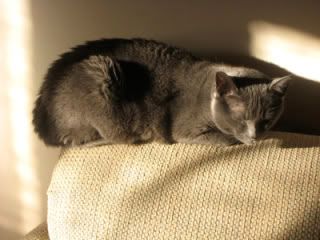
Mighty hunter stalks the wild cat treat!
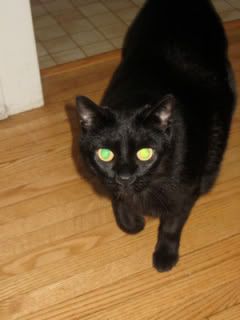
Me and my shadow…
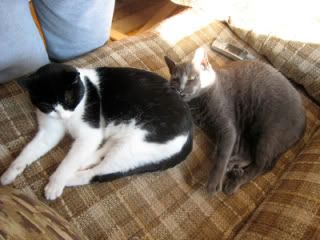
What's it to you…punk?
See, I told you cats were a liquid.

Mighty hunter stalks the wild cat treat!

Me and my shadow…

What's it to you…punk?

See, I told you cats were a liquid.

Thursday, January 21, 2010
Newbie Question #5
5. What do you consider the most important principle of fiction?
This is a good one, and I'd love to start a discussion about it because I'm not sure I have a ready answer.
My first impulse is to quote Stunk & White: Be Bold. Be Clear.
But I'm not sure that's a "principle," per se. I know that when I was first starting out, I spent a lot of time arguing with other genre writers about the importance of clarity. Some people thought that it was more important to be clever. They thought my preference for understandability meant that I wanted to appeal to the least common denominator, sell my soul for commercial success, and otherwise abandon the craft.
For me, the issue was that I wanted to tell a story that would be heard/read.
Ironically, the people with whom I had this argument are also commerically published now, so I guess that in the end clever and clarity aren't nearly as mutually exclusive as I first thought.
But I don't think that's really what's being asked here. I think you want to know what aspect of the craft you should concentrate on the most: plot, character, or what have you.
My answer is still the same. In the interest of being bold and clear, focus on story telling in general. Maybe for you that means you need to strengthen your characters. For me, it meant learning everything about plot... (because that's my weakest area.)
What do the rest of you think?
Wednesday, January 20, 2010
Newbie Question #4*
4. How do you get ideas for stories?
A lot writers have weighed in on this question, but I love Neil Gaiman's response, and I respectfully suggest you read what he has to say.
The joke answer "from an idea factory in Schenectady [New York]" has been attributed to a number of science fiction writers from Ray Bradbury to Harlan Ellison.
My own answer builds on what Gaiman says in his essay, which is, essentially, ask questions and let those questions lead you to more questions. My addition is: cultivate a sense of wonder.
I will admit that I'm not one of those writers that complain of having not enough time for all the ideas brimming over in their mind. I often actually have to sit down and coax ideas out of my head. (Characters... now THOSE I often have to spare -- all waiting impatiently in my head for their story to come to me.) When I'm starting a proposal, I'll pull out pen and paper and start scribbling out thoughts. If I have a character in mind, I might just start by asking myself the simple question: "What's the worst thing that could happen to this person?" and start there. Because in order to answer that question I have to know what's important to the character, the "what's at stake?" question which leads nicely to conflict which is the heart of drama.
But when I'm not on a deadline for a story idea, I cultivate a sense of wonder by reading everything I can get my hands on. I read fiction. I read non-fiction on any subject that attracts me (I have a whole book, for instance, on the history of grave robbing that, believe it or not, has worked into my vampire stories.) As a former science fiction writer, I also read popular science -- well, literally, as I'm a long time subscriber to the magazine Popular Science.
I also think that story generation is easier if you're the kind of person who looks at the world and automatically thinks: "Huh, I wonder why things are this way?" or "Why is that person who s/he is?"
So the short answer is... be open, ask questions... and, if you have the luxury, wait. My friend and mentor Maureen McHugh once said that ideas are like pearls. They start as a grit of something that gets into your mind and slowly other thing attach themselves to that initial bit, becoming nacre. Sometimes you just end up with a dirty oyster, but sometimes you get pearls.
-------------------------
*x-posted from Tate Hallaway's blog, where you can read the answer to newbie question #3 as well.
Tuesday, January 19, 2010
Dick Nominees
Just a note of interest:
-------------------
2009 Philip K. Dick Award Nominees Announced
The judges of the 2009 Philip K. Dick Award and the Philadelphia SF Society, along with the Philip K. Dick Trust, are pleased to announce seven nominated works that comprise the final ballot for the award:
BITTER ANGELS by C. L. Anderson (Ballantine Books/Spectra)
THE PRISONER by Carlos J. Cortes (Ballantine Books/Spectra)
THE REPOSSESSION MAMBO by Eric Garcia (Harper)
THE DEVIL’S ALPHABET by Daryl Gregory (Del Rey)
CYBERABAD DAYS by Ian McDonald (Pyr)
CENTURIES AGO AND VERY FAST by Rebecca Ore (Aqueduct Press)
PROPHETS by S. Andrew Swann (DAW Books)
First prize and any special citations will be announced on Friday, April 2, 2010 at Norwescon 33 at the Doubletree Seattle Airport Hotel, SeaTac, Washington.
-------------------
2009 Philip K. Dick Award Nominees Announced
The judges of the 2009 Philip K. Dick Award and the Philadelphia SF Society, along with the Philip K. Dick Trust, are pleased to announce seven nominated works that comprise the final ballot for the award:
BITTER ANGELS by C. L. Anderson (Ballantine Books/Spectra)
THE PRISONER by Carlos J. Cortes (Ballantine Books/Spectra)
THE REPOSSESSION MAMBO by Eric Garcia (Harper)
THE DEVIL’S ALPHABET by Daryl Gregory (Del Rey)
CYBERABAD DAYS by Ian McDonald (Pyr)
CENTURIES AGO AND VERY FAST by Rebecca Ore (Aqueduct Press)
PROPHETS by S. Andrew Swann (DAW Books)
First prize and any special citations will be announced on Friday, April 2, 2010 at Norwescon 33 at the Doubletree Seattle Airport Hotel, SeaTac, Washington.
Sunday, January 17, 2010
Friday, January 15, 2010
Friday Cat Blogging
Close the damn door!
Oh, my head…
Velicoraptor cat is here for you innards!
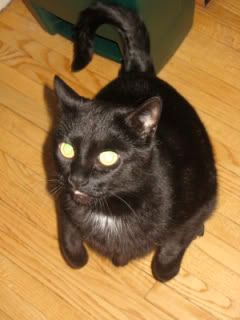
Tyranosaurus cat scoffs at puny velicoraptor cat.
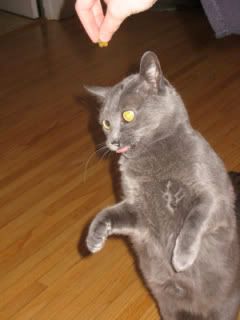

Oh, my head…

Velicoraptor cat is here for you innards!

Tyranosaurus cat scoffs at puny velicoraptor cat.

Thursday, January 14, 2010
German Cover Art

Just by chance I decided to google the title of my German release of Tall, Dark & Dead (now: Nicht Schon Wieder ein Vampir/Not Another Vampire) and discover this awesomely cute cover art. Whoot!
Wednesday, January 13, 2010
Newbie Question #2
2. How do you come up with character’s names?
Ah, yes…. Naming. If you ask me names have magic.
I tend to spend an inordinate amount of time considering Names. I have several “Baby Name” books at home (and did, years before actually having a baby to name.) There are several baby name websites out there, some which are even organized by “most popular baby names for 1976” or even 1796, so you can use them for your historical novels, as well.
Also, because I was writing before the Interwebs, I also use this analog thing called a PHONE BOOK. There are other books (and web sites) out there for surnames, but if you live in a big enough city the phone book can be fun for diverse and ethnic last names. I actually chose my pseudonym using the random finger point method and the phone book – my publisher was very insistent that I have a last name that started with an “Ha” to put me next to other vampire writers like Harrison, Harris, Hamilton, etc.
Once I have these resources in front of me, I make a list of names I like the sound of. I make a second column of surnames that sound nifty. Then I spend days (even weeks) mulling over the combinations. If I’m on a really tight deadline, I’ll start writing with [fill-in name], but I find that the name I end up picking really imbues the character with a lot of life. For instance a Darcy Farthingworth is likely going to behave differently from a Shin Yu. Maybe not, but… you can see what I mean, I hope.
That’s the other thing that I love to do: play with expectations. Sometimes I do crazy things like naming my Sunni Muslim computer hacker “Christian,” because it instantly requires me to consider how he ended up with a name like that… and suddenly I’m character building, as it were.
Also, I think it’s important when you have several characters on scene to make sure they’re not all sporting names that sound similar. Jane, Jack, and John, for instance, might be hard for a reader to keep straight in their heads, especially if you’re in the middle of a scene comprised mostly of intense dialogue between the three of them. If you have a Walter, Ahmed, and Helena it might be slightly easier. (You still will need to make sure they don’t all speak in the same voice, but I see that’s a later question so I’ll save talking about that for now.)
Pick names you want to spend time with. I think naming is one of the most fun things writers get to do, so enjoy it!
Tuesday, January 12, 2010
Questions from a Newbie*
I came into the office (aka Amore Coffee) this morning and discovered a lovely email from a young woman who is considering writing her first novel. She sent me a list of twenty-two questions about writing craft and publication, and rather than send back an email large enough to crash a server, I thought I'd answer them one by one here:
I think that if you want write believable characters it helps to be a kind of Sherlock Holmes in real life. Not necessarily the Robert Downey, Jr., pugilist version, but rather a keen observer of human nature.
Or schizophrenic.
I joke about that last bit because one of the tricks I often use when writing characters is to ask myself the question: "If I was that person in that situation, how would *I* react?" (This can be a bit embarrassing when, later, you show that scene to your writers' critique group and they explain how galatically stupid your character is behaving.) However, I think this trick can work... but only if you can really stretch your imagination in a way that might include, for instance, you being an alien or of the opposite gender or of a different social-economic class or a vampire or.... you get the picture.
Which might lead you back to Holmes...
When I draw on real people, I tend not to borrow them wholesale from reality. What I do, instead, is smoosh together traits I've observed in a several of my friends (or even family, although drawing on your family can be dangerous if only because they're always looking for themselves in your work even when you intentionally avoid putting them there.)
I think the most important trick to remember when developing a character is to think about how weird we all really are, how diverse, how interesting -- and capitalize on that wherever you can.
What I mean is -- nobody is ever just one thing. A soldier is more than his or her orders or rank. She might be a failed opera singer. He might secretly read romances. Her father might have taught her to sail. His sister might be a lesbian.
The possibilities are endless. Though you don't want to just throw in quirk to be quirky or you run the risk of coming off like late season "Gilmore Girls" and stretching the OTHER edge of credibility. For myself, I try to bring out the weird so that it serves my plot in some way. Back to the soldier example, I might try to think up some issue that would put my character in direct conflict with an order. What if this was a future where being gay was outlawed? Having the soldier have to deal with his own family would make his life more complicated. Then you build on those complications. What kind of relationship does s/he have with his/her sister? Is it a good one or bad? Which would lead to the hardest decision for our soldier hero/ine? That's the one you choose. IMHO, complications are critical to believable characters (and plot motion, but that might be a discussion for another time.)
To be a good storyteller, you have to be willing to torture your characters. Giving them an easy life kills drama.
--------
*x-posted from my Tate Hallaway blog
1. How do you develop your characters? Are they people you know?
I think that if you want write believable characters it helps to be a kind of Sherlock Holmes in real life. Not necessarily the Robert Downey, Jr., pugilist version, but rather a keen observer of human nature.
Or schizophrenic.
I joke about that last bit because one of the tricks I often use when writing characters is to ask myself the question: "If I was that person in that situation, how would *I* react?" (This can be a bit embarrassing when, later, you show that scene to your writers' critique group and they explain how galatically stupid your character is behaving.) However, I think this trick can work... but only if you can really stretch your imagination in a way that might include, for instance, you being an alien or of the opposite gender or of a different social-economic class or a vampire or.... you get the picture.
Which might lead you back to Holmes...
When I draw on real people, I tend not to borrow them wholesale from reality. What I do, instead, is smoosh together traits I've observed in a several of my friends (or even family, although drawing on your family can be dangerous if only because they're always looking for themselves in your work even when you intentionally avoid putting them there.)
I think the most important trick to remember when developing a character is to think about how weird we all really are, how diverse, how interesting -- and capitalize on that wherever you can.
What I mean is -- nobody is ever just one thing. A soldier is more than his or her orders or rank. She might be a failed opera singer. He might secretly read romances. Her father might have taught her to sail. His sister might be a lesbian.
The possibilities are endless. Though you don't want to just throw in quirk to be quirky or you run the risk of coming off like late season "Gilmore Girls" and stretching the OTHER edge of credibility. For myself, I try to bring out the weird so that it serves my plot in some way. Back to the soldier example, I might try to think up some issue that would put my character in direct conflict with an order. What if this was a future where being gay was outlawed? Having the soldier have to deal with his own family would make his life more complicated. Then you build on those complications. What kind of relationship does s/he have with his/her sister? Is it a good one or bad? Which would lead to the hardest decision for our soldier hero/ine? That's the one you choose. IMHO, complications are critical to believable characters (and plot motion, but that might be a discussion for another time.)
To be a good storyteller, you have to be willing to torture your characters. Giving them an easy life kills drama.
--------
*x-posted from my Tate Hallaway blog
Monday, January 11, 2010
Monday Morning WIP
Since Kelly is off boogie boarding in Hawaii, I will ask the question he usually does: what are y'all up to today?
Me, I'm currently avoiding writing a 500 word article for a German magazine to promote the publication of Tate's NICHT SCHON WIEDER EIN VAMPIR (Not Another Vampire) aka TALL, DARK & DEAD. Which reminds me, I should e-mail Tate's agent and ask if there is cover art for NICHT....
Then it will be back to the RESURRECTION CODE salt mines.
You?
Me, I'm currently avoiding writing a 500 word article for a German magazine to promote the publication of Tate's NICHT SCHON WIEDER EIN VAMPIR (Not Another Vampire) aka TALL, DARK & DEAD. Which reminds me, I should e-mail Tate's agent and ask if there is cover art for NICHT....
Then it will be back to the RESURRECTION CODE salt mines.
You?
Friday, January 08, 2010
Friday Cat Blogging
Triangle cat is triangular
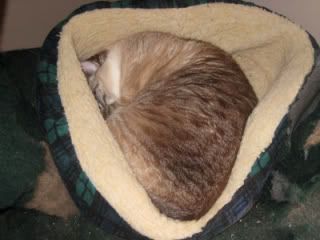
Sunnn…
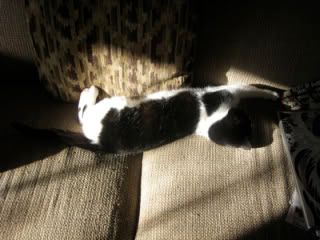
I am suspicious of you
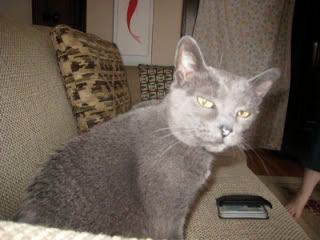
My evil plan, it is almost ready to go
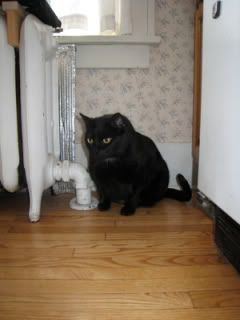

Sunnn…

I am suspicious of you

My evil plan, it is almost ready to go

Wednesday, January 06, 2010
What I Learned at Wyrdsmiths
One of the last times we were all gathered at Wyrdsmiths, I made a list of the profound things people said during critique. Here's what I learned:
1. It's always nice to see a scarecrow choke a jock.
2. Faeries are liars.
3. It's time for squids to start falling like snow.
4. Hooey will jump out at you.
5. One god per chapter.
6. Avoid the verb "to be" if you possibly can.
1. It's always nice to see a scarecrow choke a jock.
2. Faeries are liars.
3. It's time for squids to start falling like snow.
4. Hooey will jump out at you.
5. One god per chapter.
6. Avoid the verb "to be" if you possibly can.
Where Is Everybody?
I guess this is a Wednesday Morning WIP post because I'm curious where everyone has been. For myself, I've been heads-down over RESURRECTION CODE which I'm bound and determined to finish by early February. (I've already missed not one, but two deadlines.)
So how are you? Where are you? What have you been doing?
So how are you? Where are you? What have you been doing?
Monday, January 04, 2010
What I Did Over Winter Vacation

This is a picture Sean M. Murphy shot of Mason heading down the hill at the Country Club. Awesome, no?
Friday, January 01, 2010
Happy New Year
Best wishes to all for the century's teens, and thanks to Kelly for all the nifty cat pictures.
Friday Cat Blogging New Year's Day
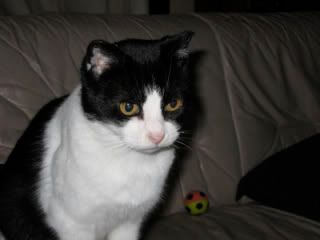
I don't think so.
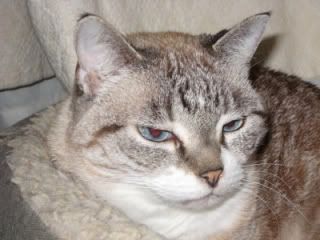
Om, just om.
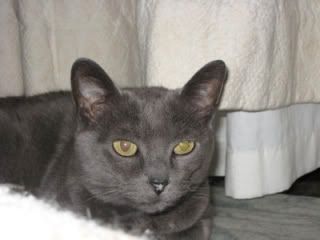
Why yes, I did have an uncle who was pot-bellied pig, how did you guess?.
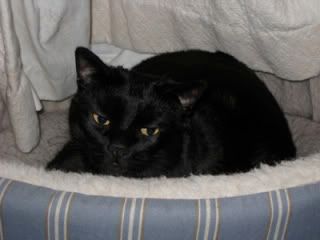
Shh, I'm killing fishes with my mind.
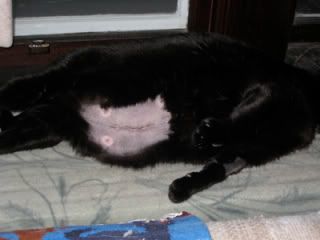
You want to see my stitches? I show you them.
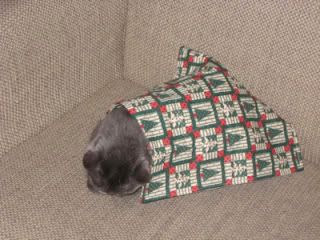
Happy New Year already, now will you shut up and let me sleep this off?

Om, just om.

Why yes, I did have an uncle who was pot-bellied pig, how did you guess?.

Shh, I'm killing fishes with my mind.

You want to see my stitches? I show you them.

Happy New Year already, now will you shut up and let me sleep this off?

Subscribe to:
Posts (Atom)