Friday, July 29:
7:00-7:30 PM, Main Stage (Soo Line)
Scott Lohman, MC; David G. Hartwell, John Calvin Rezmerski, Lyda Morehouse, Joan Slonczewski, Eric M. Heideman; Vincent Price, C.L. Moore, in absentia
9:30-10:25 PM, Main Stage
Fiction Reading: Lyda Morehouse reads from the work of Lyda Morehouse and/or Tate Hallaway
Saturday, July 30:
1:00-1:55 PM, Main Stage
Panel: The Future is Serious Dark for 16 Year Olds
From Scott Westerfield's Uglies to Suzanne Collins' Hunger Games (even the final Harry Potter book, to some extent) there are a surprising amount of very dark futures topping bestseller lists. On a related issue: Why are so many Young Adult SF/F heroines emotionally distant murderers?
Lyda Morehouse, mod.; S.N. Arly, Naomi Kritzer, David Lenander, Michael Levy
2:00-2:55 PM Krushenko's (Room 101)
Panel: Captain America: The Comic, the Legend, the Movie
We'll take a breezy tour of the history of Timely/Marvel's early super hero icon, created (1941-)by Joe Simon and Jack Kirby, then talk about the film that premiered July 22. Faithful rendition or fan fail? Did it live up to the hype, etc.? Current comic book lines we wish they'd tap for sequels.
Lyda Morehouse, mod.; Eleanor Arnason, Cynthia Booth, Roy C. Booth
3:00-3:55 PM Main Stage
Panel: YA Market Explosion
Some say science fiction hasn't produced many blockbusters in recent years, yet science fiction shows up constantly on Young Adult bestseller lists. Why? What's the crossover appeal of these works?
Lyda Morehouse, mod.; Roy C. Booth, Naomi Kritzer, Michael Levy, Joan Marie Verba
5:00-5:30 PM Railroad Lobby (near Registration)
Massive Autographing: David G. Hartwell, Joan Slonczewski, Lyda Morehouse, John Calvin Rezmerski, Roy C. Booth, Catherine Lundoff
Sunday, July 31:
Noon-12:55 PM Main Krushenko's Annex (Northern Pacific)
Panel: Thor: The God, the Comic, the Movie
We'll dip a bit into Norse mythology, dip a bit more into the comic created (1962-) by Stan Lee, Larry Lieber, and Jack Kirby, then consider the May movie. God-like or Thunderously Disappointing?
Lyda Morehouse, mod.; S.N. Arly, Eleanor Arnason, Roy C. Booth, Terry Faust
3:00-3:55 PM Main Stage
Discussion: The Works of Lyda Morehouse and Tate Hallaway
Come, talk and ask questions about the work of our Special Guest and her mysterious alter ego.
David Lenander, mod.; Lyda Morehouse. Sponsored by the Rivendell Group, a fantasy-book discussion group that has met regularly since late 1973 or early 1974.
5:00-5:30 PM Main Stage
Closing Ceremonies
Scott Lohman, MC; David G. Hartwell, Lyda Morehouse, John Calvin Rezmerski, Eric M. Heideman; Joan Slonczewski, C.L. Moore, in absentia
Friday, July 29, 2011

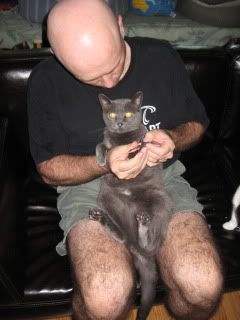
Friday Cat Blogging
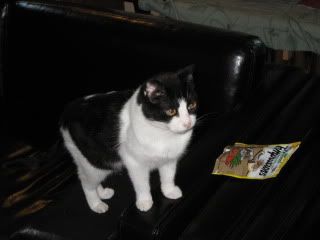
If I hadn't just had my claws trimmed, I'd open it myself.
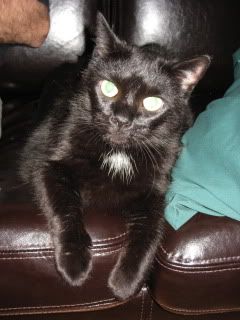
I can't believe you just did that to my feet!
If you try to trim my claws, I will kill you with my mind.
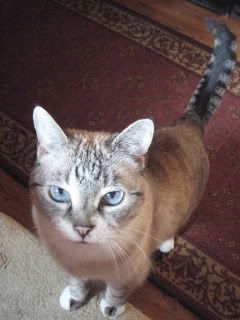
Oh my god! He's disarming me! Help!
Bonus Rocky Mountain Kitties:
They are coming!
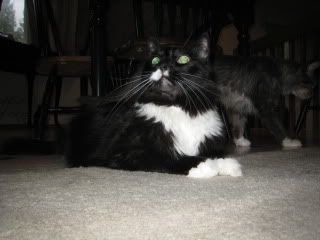
I will destroy them with my laser eyes.
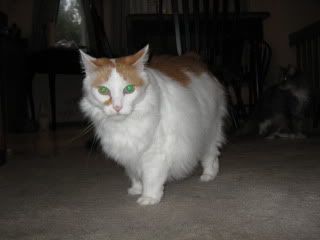
Lear…King Lear. Wait, who are coming?
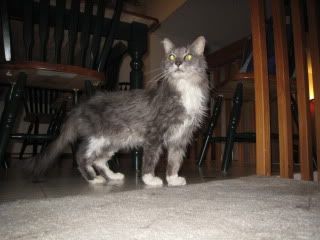

I can't believe you just did that to my feet!

If you try to trim my claws, I will kill you with my mind.

Oh my god! He's disarming me! Help!

Bonus Rocky Mountain Kitties:
They are coming!

I will destroy them with my laser eyes.

Lear…King Lear. Wait, who are coming?

Thursday, July 28, 2011

Don't Forget...!
I'll be reading (or taking part in a discussion?) at Dreamhaven Books tonight from 6:30 - 7:30 pm as part of the Speculations Reading Series, along with fellow Diversicon honored guests David Hartwell and John Calvin Rezmerski.
Hmmm... I hadn't really read that first bit very carefully. Perhaps I _don't_ need to figure out what I need to read tonight....
Either way, it's bound to be a good time. Please join us!
Hmmm... I hadn't really read that first bit very carefully. Perhaps I _don't_ need to figure out what I need to read tonight....
Either way, it's bound to be a good time. Please join us!
A Secret Admirer or Scary Stalker?
There's a secret, hidden asteroid that's been following Earth for thousands of years. They're calling it the Trojan Asteroid.
Isn't that the planet Gor or something?
Isn't that the planet Gor or something?
Wednesday, July 27, 2011
Learning to Write
I ran across a reference to Julia Cameron's The Artist's Way. It sounded interesting, so I got a Nook copy. It's a book on breaking through creative blocks. I guess that's as good a way of describing it as any: part 12-step program, part self-psychoanalysis and part the practice of writing. It makes me uneasy, because Cameron talks about God a lot. However, I've been playing with the book, trying some of the exercises.
One exercise is to write three pages every morning, without planning or revising. Just get words on paper. I have found this very hard. Mostly I write, "I have nothing to say." Of course, I don't have a writer's block, and if I am writing, I want to be writing my current story. Though I could write more. I figure the exercise is to get one in the habit of writing. Maybe I need that.
The next exercise I like: make an artist's date with oneself, a block of time to go out alone to do something that feeds the creative impulse. So I went walking along the river last week. I'm thinking of going to museums, attending concerts. None of these require company.
Another exercise is pick five careers you'd like for yourself. I picked paleontolgist, bird watcher, traveler, poet and social thinker. I do three of the five, to one extent or another. I could do the fourth -- traveling. Nothing holds me back. The fifth -- paleontologist -- is a dream. I don't really want to be somewhere in the desert with blazing heat and no bathrooms, digging up fossils. And I don't want to be sitting in a museum somewhere, using a dental pick and a toothbrush to free bones from their matrices. I like reading and thinking about paleontology.
I guess another dream career would be union organizing. But I've tried organizing. I'm terrible at it.
Maybe it would be easier to write.
I also started rereading Natalie Goldberg's Long, Quiet Highway, which is about writing and Zen practice; and I got the Nook version of her how-to book about writing, Writing Down the Bones.
Why am I doing this? Maybe I will learn something.
One exercise is to write three pages every morning, without planning or revising. Just get words on paper. I have found this very hard. Mostly I write, "I have nothing to say." Of course, I don't have a writer's block, and if I am writing, I want to be writing my current story. Though I could write more. I figure the exercise is to get one in the habit of writing. Maybe I need that.
The next exercise I like: make an artist's date with oneself, a block of time to go out alone to do something that feeds the creative impulse. So I went walking along the river last week. I'm thinking of going to museums, attending concerts. None of these require company.
Another exercise is pick five careers you'd like for yourself. I picked paleontolgist, bird watcher, traveler, poet and social thinker. I do three of the five, to one extent or another. I could do the fourth -- traveling. Nothing holds me back. The fifth -- paleontologist -- is a dream. I don't really want to be somewhere in the desert with blazing heat and no bathrooms, digging up fossils. And I don't want to be sitting in a museum somewhere, using a dental pick and a toothbrush to free bones from their matrices. I like reading and thinking about paleontology.
I guess another dream career would be union organizing. But I've tried organizing. I'm terrible at it.
Maybe it would be easier to write.
I also started rereading Natalie Goldberg's Long, Quiet Highway, which is about writing and Zen practice; and I got the Nook version of her how-to book about writing, Writing Down the Bones.
Why am I doing this? Maybe I will learn something.
Tuesday, July 26, 2011
Welcome!!
Wyrdsmiths is proud to announce that we have added a new member to our ranks. Let me introduce to you: Adam Stemple.
Adam Stemple is an author, musician, web designer, and professional card player. He has written four novels, including Pay the Piper (with Jane Yolen), winner of the 2006 Locus Award for Best Young Adult Book. Of his debut solo novel, Singer of Souls, Anne McCaffrey said, "One of the best first novels I have ever read."
If you're not yet impressed, his entire list of credentials is here.
Adam Stemple is an author, musician, web designer, and professional card player. He has written four novels, including Pay the Piper (with Jane Yolen), winner of the 2006 Locus Award for Best Young Adult Book. Of his debut solo novel, Singer of Souls, Anne McCaffrey said, "One of the best first novels I have ever read."
If you're not yet impressed, his entire list of credentials is here.
Monday, July 25, 2011
Why Shouldn't Writers Use Their Time Machines?
Eleanor Arnason is right and I'm wrong. I can feel it in the back of my head, burbling away in that pot that I left sitting on the back burner. But I don't know why I'm wrong, or how to be right, so it's not the most helpful feeling.
At Wyrdsmiths last Thursday night, I suggested moving the start of a novel up a couple of scenes, to where the intrigue really kicks in: a character knocks at a doorway of a run-down, vacant looking storefront where they've been directed to find a strange organization. They end up waiting at the door, letting suspense build. I suggested starting there, then popping back to establish what happened to bring them to that point while the character is waiting, then re-establish the here and now moment when the door opens and they are drawn inside.
Eleanor stopped me and said she hates the use of the flashback, and that backstory should just be layered in as the story goes forward. My gut says that she is right, that relying on the flashback can be a cheap way out of a complicated situation, and the weaker option in creating a well-structured story. BUT...
...I don't know how else to do it, aside from straight up character recollection/exposition. I know that the audience will need certain information to understand what's going on, and to be introduced to certain characters, and to develop sympathy with the main character(s). Backstory is a well-established literary device. But sometimes that information isn't available outside the context of its own scene.
In a time-travel story, backstory can be established in the main flow, as the characters experience the jump in the time flow with the reader and are thus moving forward even as they replay the past. It's not so easy outside of that specific device, though, and I'd like to hear what our denizens have found effective in layering in backstory, either in your own work or in stories you've read. What works well, and what doesn't? And, if you'll share, why?
At Wyrdsmiths last Thursday night, I suggested moving the start of a novel up a couple of scenes, to where the intrigue really kicks in: a character knocks at a doorway of a run-down, vacant looking storefront where they've been directed to find a strange organization. They end up waiting at the door, letting suspense build. I suggested starting there, then popping back to establish what happened to bring them to that point while the character is waiting, then re-establish the here and now moment when the door opens and they are drawn inside.
Eleanor stopped me and said she hates the use of the flashback, and that backstory should just be layered in as the story goes forward. My gut says that she is right, that relying on the flashback can be a cheap way out of a complicated situation, and the weaker option in creating a well-structured story. BUT...
...I don't know how else to do it, aside from straight up character recollection/exposition. I know that the audience will need certain information to understand what's going on, and to be introduced to certain characters, and to develop sympathy with the main character(s). Backstory is a well-established literary device. But sometimes that information isn't available outside the context of its own scene.
In a time-travel story, backstory can be established in the main flow, as the characters experience the jump in the time flow with the reader and are thus moving forward even as they replay the past. It's not so easy outside of that specific device, though, and I'd like to hear what our denizens have found effective in layering in backstory, either in your own work or in stories you've read. What works well, and what doesn't? And, if you'll share, why?
Sunday, July 24, 2011
APOD with NASA Commentary

An example of solar-powered flight, NASA's Helios aircraft flew almost one hundred years after the Wright brothers' historic flight on December 17, 1903. Pictured here at 3,000 meters in in skies northwest of Kauai, Hawaii, USA in August 2001, the remotely piloted Helios is traveling at about 40 kilometers per hour. Essentially an ultralight flying wing with 14 electric motors, the aircraft was built by AeroVironment Inc. Covered with solar cells, Helios' impressive 247 foot wide wing exceeded the wing span and even overall length of a Boeing 747 jet airliner. Climbing during daylight hours, the prototype aircraft ultimately reached an altitude just short of 30,000 meters, breaking records for non-rocket powered flight. Helios was intended as a technology demonstrator, but in the extremely thin air 30,000 meters above Earth's surface, the flight of Helios also approached conditions for winged flight in the atmosphere of Mars.
Saturday, July 23, 2011
APOD with NASA Commentary

Magnificent island universe NGC 2403 stands within the boundaries of the long-necked constellation Camelopardalis. Some 10 million light-years distant and about 50,000 light-years across, the spiral galaxy also seems to have more than its fair share of giant star forming HII regions, marked by the telltale reddish glow of atomic hydrogen gas. In fact, NGC 2403 closely resembles another galaxy with an abundance of star forming regions that lies within our own local galaxy group, M33 the Triangulum Galaxy. Of course, supernova explosions follow close on the heels of the formation of massive, short-lived stars and in 2004 one of the brightest supernovae discovered in recent times was found in NGC 2403. Easy to confuse with a foreground star in our own Milky Way Galaxy, the powerful supernova is seen here as the spiky, bright "star" at the left edge of the field. This stunning cosmic portrait is a composite of space and ground-based image data from the Hubble Legacy Archive and the 8.2 meter Subaru Telescope at the summit of Mauna Kea, Hawaii.
Friday, July 22, 2011
Friday 13 Cats Blogging
BIRD!!!!!!!
Oink?
What is your wish my mathter?
Come over here and let me smack you one.
Gross! Have you seen what's on your foot?
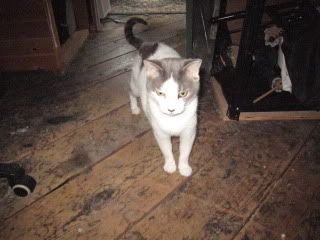
Duuuuude…
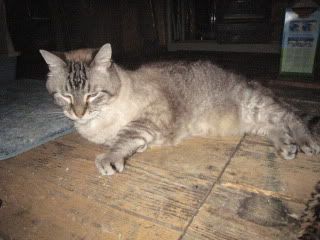
This is as frolicky as I get. Deal.
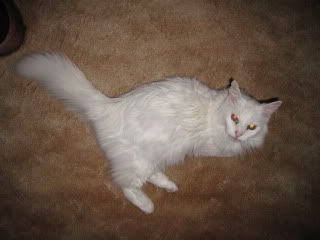
You don't really expect me to believe that, do you?
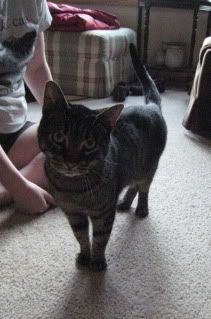
I see food people.…
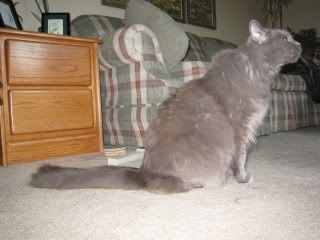
You let the damn paparazzi in again, didn't you?
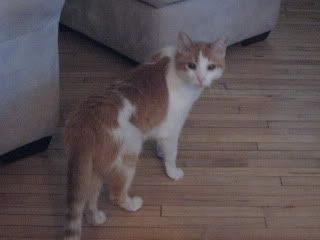
Evvvvvery side is my good side.
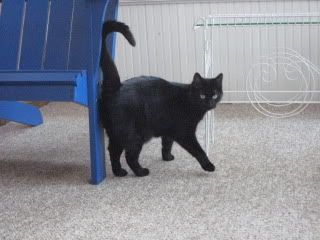
Weren't you supposed to be peeling me a grape?
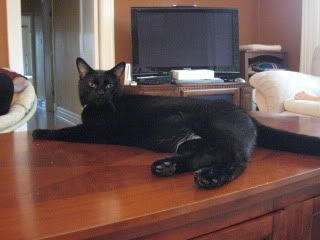
And then to bed, and then to bed…


Oink?

What is your wish my mathter?

Come over here and let me smack you one.

Gross! Have you seen what's on your foot?

Duuuuude…

This is as frolicky as I get. Deal.

You don't really expect me to believe that, do you?

I see food people.…

You let the damn paparazzi in again, didn't you?

Evvvvvery side is my good side.

Weren't you supposed to be peeling me a grape?

And then to bed, and then to bed…

Get it While It's Hot!
According to "Monstrous Musings" Douglas Cohen's/the RoF LJ, today is the last day you can subscribe to Realms and still receive the August issue, which includes the short story "Isabella's Garden" by our very own Naomi Kritzer!
More on Diversicon
I certainly never meant to imply that a small con isn't a great deal of fun. In fact, I was merely trying to coax more people into coming and enjoying the awesome that is Diversicon.
Some of my very best one-on-one experiences have been in very small cons. I got to spend an hour interviewing Neil Gaiman at a con with even fewer attendees than Diveriscon often expects. At the same con, I had a fantastic panel with him talking about comic books... something I would never be able to do at a con the size of CONvergence or even WisCON because there are simply so many professionals for the programming folks to choose from...
Anyway, to continue to sell you on Diversicon let me give you this tantalizing bit from their Facebook page: "Diversicon is a serious, nerdy SF/Fantasy convention held in the Minneapolis/St Paul area..."
Dude, they had me at "nerdy."
Some of my very best one-on-one experiences have been in very small cons. I got to spend an hour interviewing Neil Gaiman at a con with even fewer attendees than Diveriscon often expects. At the same con, I had a fantastic panel with him talking about comic books... something I would never be able to do at a con the size of CONvergence or even WisCON because there are simply so many professionals for the programming folks to choose from...
Anyway, to continue to sell you on Diversicon let me give you this tantalizing bit from their Facebook page: "Diversicon is a serious, nerdy SF/Fantasy convention held in the Minneapolis/St Paul area..."
Dude, they had me at "nerdy."
Diversicon
I think there's an argument for small cons. Convergence is wonderful, but it's also overwhelming. A three ring circus, an over-the-top extravaganza. Even a con of under 1,000 can be tiring. Wiscon is to me, since I've gone to it for decades and know way too many people. I always miss the chance to spend time with most of them. Instead I go through the halls saying, "Hi," and not much more.
I'm glad that we have Minicon and Marscon in town, both of which are considerably larger than Diversacon, but well under 1,000. But 400+ people is still a lot. And the larger a con is, the more it's a spectator sport (if one is watching) or a performance (if one feels onstage).
I've been a show off since childhood, but I'm also introverted. Which means I perform at cons, but I find it stressful and not entirely true to who I am.
Diversicon is a quiet weekend with not very many people. Maybe I will get the chance to talk with friends, including ones I rarely see. Maybe I will meet new people and have a chance to actually spend time with them, which tends not to happen at busier conventions. I don't feel the need to show off. I can relax.
It's different pleasure than a con full of people and events. But it's a nice mid-summer break.
And Lyda and I are going to be on a Thor panel. I intend to enjoy that a lot.
I'm glad that we have Minicon and Marscon in town, both of which are considerably larger than Diversacon, but well under 1,000. But 400+ people is still a lot. And the larger a con is, the more it's a spectator sport (if one is watching) or a performance (if one feels onstage).
I've been a show off since childhood, but I'm also introverted. Which means I perform at cons, but I find it stressful and not entirely true to who I am.
Diversicon is a quiet weekend with not very many people. Maybe I will get the chance to talk with friends, including ones I rarely see. Maybe I will meet new people and have a chance to actually spend time with them, which tends not to happen at busier conventions. I don't feel the need to show off. I can relax.
It's different pleasure than a con full of people and events. But it's a nice mid-summer break.
And Lyda and I are going to be on a Thor panel. I intend to enjoy that a lot.
Thursday, July 21, 2011
Mark your Calendar!
I don't have my list of appearances yet, but I wanted to remind everyone that Diveriscon (guest of honor, includes among others, *moi*) is NEXT WEEKEND (July 29 - 31).
Also:
On Thursday, July 28, the Speculations Readings Series presents a discussion: “Dark Descents, Ascending Wonders: The Worlds of Speculative Fiction” featuring DAVID G. HARTWELL, LYDA MOREHOUSE, and JOHN CALVIN REZMERSKI. See the Diversicon 19 Guests page for more about these three authors. The event will take place 6:30-7:30pm at DreamHaven Books, 2301 E. 38th St., Minneapolis.
Please, please, please, PLEASE come to Diversicon. It's a tiny little con, and, in all honesty I'm a little worried about being stuck there without someone as cool as YOU to talk to.
Also:
On Thursday, July 28, the Speculations Readings Series presents a discussion: “Dark Descents, Ascending Wonders: The Worlds of Speculative Fiction” featuring DAVID G. HARTWELL, LYDA MOREHOUSE, and JOHN CALVIN REZMERSKI. See the Diversicon 19 Guests page for more about these three authors. The event will take place 6:30-7:30pm at DreamHaven Books, 2301 E. 38th St., Minneapolis.
Please, please, please, PLEASE come to Diversicon. It's a tiny little con, and, in all honesty I'm a little worried about being stuck there without someone as cool as YOU to talk to.
Tuesday, July 19, 2011
What Writing is REALLY like...
io9 picks out the most goofy moments in the bioptic about the life of JK Rowling. I think I particularly like the idea of the creative process as real magic with floating candles.
That's totally what happens every time *I* write.
Or, maybe, because it *doesn't,* that's why I'm not an international bestseller.
That's totally what happens every time *I* write.
Or, maybe, because it *doesn't,* that's why I'm not an international bestseller.
Monday, July 18, 2011
More on Writing
Steph Swainston on writing, via Scalzi's blog. I have to say, her life doesn't sound that bad to me. But maybe she has higher standards than I do.
Who You Looking At?
Be careful when you insult someone by calling them a Neanderthal, you could be talking about yourself.
Friday, July 15, 2011
Friday Cat Blogging Now With Bonus Cats!
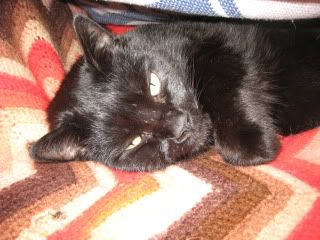
I'm a mystery wrapped in an enigma
inside a cat bed inside an even bigger cat bed!

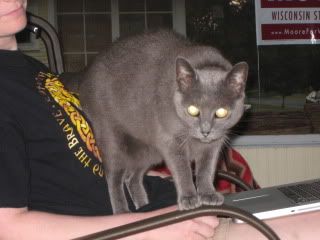
I are a huge poofy Halloween cat! Fear me!
You have interrupted me in the middle of making my
ebil plans! Now I must keel you!
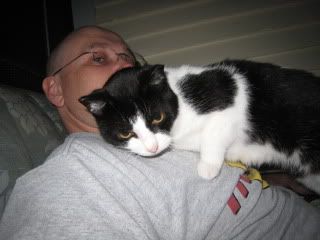
He's mine, I tell you, mine!
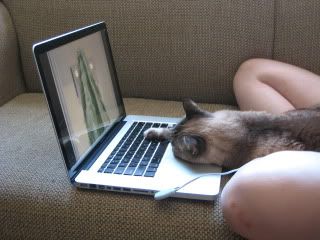
I lubs classic Dr Who, please paws this scene!
Put the lime in the coconut they said? Well, my
name is Coconut and I do not endorse this message
No you can't mail anything.
Can't you see I'm on break here?
Didn't I kill you last week?
inside a cat bed inside an even bigger cat bed!

I are a huge poofy Halloween cat! Fear me!

You have interrupted me in the middle of making my
ebil plans! Now I must keel you!

He's mine, I tell you, mine!

I lubs classic Dr Who, please paws this scene!

Put the lime in the coconut they said? Well, my
name is Coconut and I do not endorse this message

No you can't mail anything.
Can't you see I'm on break here?

Didn't I kill you last week?

Thursday, July 14, 2011
How to Write Mid List Fiction # 1
I have been reading Kristine Katherine Rusch on the business of writing, because it's been a long time since I thought about writing as a business, and publishing is changing, due to Kindle and Nook. She sounds authoritative, and the topic is interesting to me at the moment.
Then I got to her advice on how to write, if you're going to survive as a writer. I'm less sure about this.
Rusch says writers should think of themselves as storytellers, rather than authors. I think she's telling people to not take themselves too seriously. Don't think of yourself as a fine art or literary writer.
She says writers should write fast, not worry about revising and not worry about style. Practice will make one a better writer and practice will enable one to find one's "voice."
According to Rusch, the famous writers -- the ones we still read, like Dickens and Shakespeare -- wrote fast. It is certainly my impression that Dickens was a fast writer. He wrote 14.5 novels in 34 years. That's half a large novel a year, which is impressive, but not as impressive as Rusch, who can write four to six novels a year.
Shakespeare wrote 1.6 plays a year during his working life, which is lot more than most modern playwrights, though Shaw must have him beat. Again, this is impressive, but not as impressive as the number of words Rusch has put out. Remember that a play script is a lot shorter than a novel.
Then there are the novelists who were far less prolific: Emily Bronte (1 novel), Charlotte Bronte (4), Herman Melville (4), Jane Austen (6), Lady Murasaki (1), Wu Cheng'en (2). This is off the top of my head. All these people are still read. I am not an Emily Bronte fan, but I love Jane Eyre, Moby Dick, The Tale of Genji, The Journey to the West and all of Jane Austen's novels.
I suspect all of these writers revised and thought about style. Shakespeare had an amazing vocabulary and was a master of the mot juste. I don't think that this came out of nowhere or even from writing a lot. It came from study and thought and craft. Here is Macbeth, after murdering King Duncan:
And from a dictionary:
I add the dictionary quote because it's interesting, and "incarnadine" is a neat word. It rolls off the tongue. Redness spills from it.
Then I got to her advice on how to write, if you're going to survive as a writer. I'm less sure about this.
Rusch says writers should think of themselves as storytellers, rather than authors. I think she's telling people to not take themselves too seriously. Don't think of yourself as a fine art or literary writer.
She says writers should write fast, not worry about revising and not worry about style. Practice will make one a better writer and practice will enable one to find one's "voice."
According to Rusch, the famous writers -- the ones we still read, like Dickens and Shakespeare -- wrote fast. It is certainly my impression that Dickens was a fast writer. He wrote 14.5 novels in 34 years. That's half a large novel a year, which is impressive, but not as impressive as Rusch, who can write four to six novels a year.
Shakespeare wrote 1.6 plays a year during his working life, which is lot more than most modern playwrights, though Shaw must have him beat. Again, this is impressive, but not as impressive as the number of words Rusch has put out. Remember that a play script is a lot shorter than a novel.
Then there are the novelists who were far less prolific: Emily Bronte (1 novel), Charlotte Bronte (4), Herman Melville (4), Jane Austen (6), Lady Murasaki (1), Wu Cheng'en (2). This is off the top of my head. All these people are still read. I am not an Emily Bronte fan, but I love Jane Eyre, Moby Dick, The Tale of Genji, The Journey to the West and all of Jane Austen's novels.
I suspect all of these writers revised and thought about style. Shakespeare had an amazing vocabulary and was a master of the mot juste. I don't think that this came out of nowhere or even from writing a lot. It came from study and thought and craft. Here is Macbeth, after murdering King Duncan:
Will all great Neptune's ocean wash this blood
Clean from my hand? No, this my hand will rather
The multitudinous seas incarnadine,
Making the green one red.
And from a dictionary:
incarnadine
1591 (adj.) "flesh-colored," from Fr. incarnadine, from It. incarnadino "flesh-color," from L.L. incarnatio (see incarnation). The verb properly would mean "to make flesh colored," but the modern meaning "make red," and the entire survival of the verb, is traceable to "Macbeth" II ii. (1605).
I add the dictionary quote because it's interesting, and "incarnadine" is a neat word. It rolls off the tongue. Redness spills from it.
How to Write Mid List Fiction # 2
Rusch is talking about production writing. I borrow the term from weaving. When you go to an art fair and find handmade scarves for $50, you are looking at the work of a production weaver. Rather than make elaborate and difficult works, which will cost a lot and may not sell, she makes many works quickly: scarves, table runners, napkins. This is not bad work. Often it's lovely. But it's designed to be turned out quickly and to sell at an affordable price.
There are production potters and silversmiths. I have a lot of work by both. The point is to do work that is predictable and can be turned out quickly. Experiments take time and may fail and have to be redone. You do them to learn. But if every piece is an experiment, you are going to lose money.
Rusch excludes "literary" writers, the people who live off grants and teaching, from her discussion; and she excludes writers with day jobs, and writers who do well enough to publish a book every few years. As far as I know, Harper Lee has been living off To Kill a Mockingbird since 1960.
I think she underestimates the number of writers who can live off one book a year. That is the normal production rate for the mystery writers I read. This is time enough to revise and think about style, unless you are slow as I am.
But she is talking about production rates that amaze me: four to six books a year!
I can't argue with her advice to production writers. I can't imagine wanting to be one. I try to make everything I write an experiment of one kind or another. If I think I've written this particular story before, I toss it. I revise. I worry about style, constantly tinkering with words.
I have never come close to making a living as a writer. I once told an editor that what I made from writing kept me in conventions and Laura Ashley skirts. It's pocket money.
So, why do I write? To entertain myself. To deal with life. To impress my friends and relatives. To gain praise and pocket money. I would like undying fame, but will keep on without it.
There are production potters and silversmiths. I have a lot of work by both. The point is to do work that is predictable and can be turned out quickly. Experiments take time and may fail and have to be redone. You do them to learn. But if every piece is an experiment, you are going to lose money.
Rusch excludes "literary" writers, the people who live off grants and teaching, from her discussion; and she excludes writers with day jobs, and writers who do well enough to publish a book every few years. As far as I know, Harper Lee has been living off To Kill a Mockingbird since 1960.
I think she underestimates the number of writers who can live off one book a year. That is the normal production rate for the mystery writers I read. This is time enough to revise and think about style, unless you are slow as I am.
But she is talking about production rates that amaze me: four to six books a year!
I can't argue with her advice to production writers. I can't imagine wanting to be one. I try to make everything I write an experiment of one kind or another. If I think I've written this particular story before, I toss it. I revise. I worry about style, constantly tinkering with words.
I have never come close to making a living as a writer. I once told an editor that what I made from writing kept me in conventions and Laura Ashley skirts. It's pocket money.
So, why do I write? To entertain myself. To deal with life. To impress my friends and relatives. To gain praise and pocket money. I would like undying fame, but will keep on without it.
Wednesday, July 13, 2011
The Last Approach

For the last time, the US Space Shuttle has approached the International Space Station (ISS). Following a dramatic launch from Cape Canaveral last week that was witnessed by an estimated one million people, Space Shuttle Atlantis on STS-135 lifted a small crew to a welcome rendezvous three days ago with the orbiting station. Although NASA is discontinuing the aging shuttle fleet, NASA astronauts in the near future will be able to visit the ISS on Russian space flights. Pictured above, Atlantis rises toward the ISS with its cargo bay doors open, showing a gleaming metallic Raffaello Multi-Purpose Logistics Module. Over 200 kilometers below lie the cool blue waters of planet Earth. The much-anticipated last glide back to Earth for the Space Shuttle is currently scheduled for next Thursday, July 21.
Tuesday, July 12, 2011
More Book Stuff
How to have a successful booksigning at "Pimp My Novel" (did you even know such a blog existed?)
Also, the day before, the same blog dicusses to self-publish or not.
Also, the day before, the same blog dicusses to self-publish or not.
Monday, July 11, 2011
In Reply to Shawn re. e-books and self-publishing
The following began as a reply to Shawn Enderlin's comment on Eleanor's post re. e-publishing. Mine got long enough that a full post seemed appropriate....
I see you point Shawn, but I think the sky isn't going to be falling quite so fast or completely as some people are claiming. E-books are taking up a larger share of the market, but the number of people with e-readers is still a smaller percentage of the overall reading public. This, too, will change, but I don't see it becoming an all-or-nothing situation, as is so often seems to be painted by some e-advocates.
Too often, I think people forget the essential privileged status of the e-reader user. People who either choose not to use, or cannot afford, electronic readers/smart phones/tablets will still need a reading medium, as will many libraries and other markets. POD (print on demand) could help satisfy some of this, but that assumes either an awareness or an accessibility by the general reading public that isn't a guaranteed constant. In short, there will still be a need to more traditional, or traditional-like, distribution channels for a long time. The need may shrink, or alter, of the like, but it will be there.
By its very nature, one of the challenges of self-publishing is the exact thing you mention: distribution (in terms of people seeing your title in various locales). Yes, there are examples of people making money by self-pubbed books, but these still tend to be the notable exceptions. When you look at the vast raft of self-pubbed e-books out there, the trick is not being a success, but even getting noticed. Admittedly, this is also a problem for traditional print authors as well. I point this out not as a dig at self-pubbing, but rather because, in the case of e-pubbing, I see it too often brushed over with the "the reader will will find you if the book is good enough" placebo. That is true of either medium, and you can find examples of authors on this very blog who could tell you about the challenges of being "found" in a narrower pool (paper book) than you are looking at in the e-end. Going kindle isn't going to solve the fundamental challenge of being picked up by a reader.
I don't dismiss the power and potential of e-books and self-pubbing, but I also don't think it is the high-holy that its strongest advocated are painting it to be, either. Traditional publishing is going to have to change, and it may be ugly for a while; but I think there is still a basic enough desire and need for the services and products they provide that people shouldn't be writing them off without doing their own homework first (as you seem to have done), rather than simply following the band leader of choice (which I have seen others do).
At base, publishing is a business: deciding whether you want to sign on with a firm (traditional publishing) or have your own start-up (self-publishing) deserves just as much thought and research as starting a brick and mortar establishment in some ways. Each brings benefits and challenges, and neither is the end-all, be-all at this point in time; nor will they be for some time to come, IMO.
I see you point Shawn, but I think the sky isn't going to be falling quite so fast or completely as some people are claiming. E-books are taking up a larger share of the market, but the number of people with e-readers is still a smaller percentage of the overall reading public. This, too, will change, but I don't see it becoming an all-or-nothing situation, as is so often seems to be painted by some e-advocates.
Too often, I think people forget the essential privileged status of the e-reader user. People who either choose not to use, or cannot afford, electronic readers/smart phones/tablets will still need a reading medium, as will many libraries and other markets. POD (print on demand) could help satisfy some of this, but that assumes either an awareness or an accessibility by the general reading public that isn't a guaranteed constant. In short, there will still be a need to more traditional, or traditional-like, distribution channels for a long time. The need may shrink, or alter, of the like, but it will be there.
By its very nature, one of the challenges of self-publishing is the exact thing you mention: distribution (in terms of people seeing your title in various locales). Yes, there are examples of people making money by self-pubbed books, but these still tend to be the notable exceptions. When you look at the vast raft of self-pubbed e-books out there, the trick is not being a success, but even getting noticed. Admittedly, this is also a problem for traditional print authors as well. I point this out not as a dig at self-pubbing, but rather because, in the case of e-pubbing, I see it too often brushed over with the "the reader will will find you if the book is good enough" placebo. That is true of either medium, and you can find examples of authors on this very blog who could tell you about the challenges of being "found" in a narrower pool (paper book) than you are looking at in the e-end. Going kindle isn't going to solve the fundamental challenge of being picked up by a reader.
I don't dismiss the power and potential of e-books and self-pubbing, but I also don't think it is the high-holy that its strongest advocated are painting it to be, either. Traditional publishing is going to have to change, and it may be ugly for a while; but I think there is still a basic enough desire and need for the services and products they provide that people shouldn't be writing them off without doing their own homework first (as you seem to have done), rather than simply following the band leader of choice (which I have seen others do).
At base, publishing is a business: deciding whether you want to sign on with a firm (traditional publishing) or have your own start-up (self-publishing) deserves just as much thought and research as starting a brick and mortar establishment in some ways. Each brings benefits and challenges, and neither is the end-all, be-all at this point in time; nor will they be for some time to come, IMO.
Sunday, July 10, 2011
Storm on Saturn (Courtesy of Cassini and NASA)

A storm on Saturn, so big that it wraps all the way around the planet. Photo taken by the Cassini space probe and posted on Phil Plait's Bad Astronomy blog.
Chris on E-Reading
I should also mention the comment by Chris on my "Publishing and E-Publishing" post of
July 6. She talks about ways to find the e-books you want to read. Again, this is all interesting stuff. This is our future, as writers and readers, that is being talked about.
July 6. She talks about ways to find the e-books you want to read. Again, this is all interesting stuff. This is our future, as writers and readers, that is being talked about.
Shawn Enderlin on E-Publishing
Shawn Enderlin has a good comment on my "More About E-Publishing" post of July 6. If you are interested in this topic -- I certainly am -- then go read it.
Saturday, July 09, 2011
Last Launch

Space shuttle orbiter Atlantis left planet Earth on Friday, July 8, embarking on the STS-135 mission to the International Space Station. The momentous launch was the final one in NASA's 30 year space shuttle program that began with the launch of the first reusable spacecraft on April 12, 1981. In this reflective prelaunch image from July 7, Atlantis stands in a familiar spot on the Kennedy Space Center's pad 39A, after an early evening roll back of the pad's Rotating Service Structure. The historic orbital voyages of Atlantis have included a Hubble Space Telescope servicing mission, deployment of Magellan, Galileo, and the Compton Gamma-ray Observatory, and seven trips to the Russian space station Mir. Scheduled to dock once again with the International Space Station on Sunday, Atlantis has now made its 33rd and final trip to orbit.
Friday, July 08, 2011
Friday Cat Blogging
Could you turn the sun up a bit? This is good but…
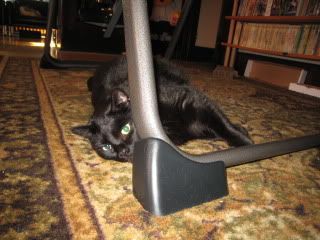
They assembled the damn thing around me…
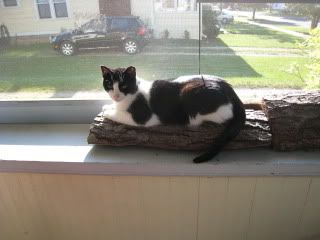
Meglet Cat of the Wild! (or reasonable facsimile therof)
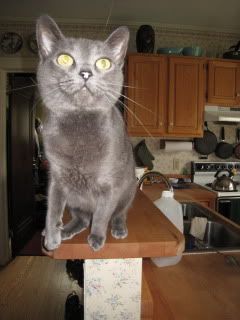
Hold that pose…I'm a jump on your head!

They assembled the damn thing around me…

Meglet Cat of the Wild! (or reasonable facsimile therof)

Hold that pose…I'm a jump on your head!

Thursday, July 07, 2011
More Stuff to Rile You Up
Scott Westerfeld talks about the WSJ kerfuffle over YA "darkness."
And the "Death of Science Fiction as Mythogenic Rejuvenation" part one and part two.
And the "Death of Science Fiction as Mythogenic Rejuvenation" part one and part two.
Even More About E-Publishing
Doug comments on my post below, asking how likely is it that anyone would buy foreign rights for a self-published e-book. Not likely, I would think. Two questions occur at once. Could English language readers get the original e-book on Amazon? This would knock out the British and Commonwealth Market. Given that translating costs money, would it be cost-effective to translate an e-book, which may be available at Amazon in English? How would it be sold? As print on paper or an e-book? How big are the markets involved? How creative are most publishers?
Doug also points out that Michael Stackpole is an established author in the world of paper books. Marketing becomes less of a problem, if people already know you name.
Finally, Stackpole writes very fast. Per his essay, he can write a novel in two months. That's six novels a year. This will give you a considerable backlist, over time. It also means you might have enough spare novels so you can try self-publishing.
If it takes you a year or more to write a novel, you are less likely to take risks with it.
I'm glad that people like Stackpole are testing the waters. I'm going to watch and see how they do.
Doug also points out that Michael Stackpole is an established author in the world of paper books. Marketing becomes less of a problem, if people already know you name.
Finally, Stackpole writes very fast. Per his essay, he can write a novel in two months. That's six novels a year. This will give you a considerable backlist, over time. It also means you might have enough spare novels so you can try self-publishing.
If it takes you a year or more to write a novel, you are less likely to take risks with it.
I'm glad that people like Stackpole are testing the waters. I'm going to watch and see how they do.
Wednesday, July 06, 2011
More About E-Publishing
In his essay Michael Stackpole writes:
A dozen books a week is 624 a year. Stackpole prices his books at $5. This results in an annual gross of $3,120. Stackpole's net will be between $2,964 and $2,184, depending on whether the books sell off his website or at Amazon.
Kelly and Lyda and Doug and Naomi can correct me, but my understanding is the current New York advance for a book by a new author is $5,000. I think there's an argument for selling to the New York houses, if you can.
The old advice for SF short fiction was start with the top markets, the ones that pay the best and are the most visible, and then work down.
It would seem to me that the hierarchy for novels starts with the New York houses, then goes to the SF specialty presses. Like the New York houses, the specialty presses produce books that look like science fiction. Some of them can get their books into chains. All of them (I think) are on Amazon. They have websites and catalogs. Many of them sell at conventions. And the best of them have good reputations. What they publish is worth looking at.
I would put self-publishing last. You get to keep more the revenue, if you self-publish, but you also do more work; and you are alone, without whatever help a publisher can provide.
When does one self-publish? My tendency right now would be to self-publish work that cannot be otherwise sold. Short story collections are very hard to sell, especially to the New York houses. Out-of-print novels have almost no market. You aren't going to make a lot of money, unless you have an extraordinary back list. But money is money, and it will mean that people who like your work can find it.
(Having said that, all of my out-of-print novels are available on Amazon, along with the three small press books I have done. All of Lyda's Archangel books are available, as are all of Naomi's books. Of course, if they are being sold by used book sellers, we don't get a cut.)
I would also argue that it's important to keep publishing, to remind yourself and the world that you are alive and writing. So if you hit a dry spell and can't sell, it may be a really good idea to self-publish a chapbook or collection or novel. It's another line in your bibliography. It's a new and recent publication date at Amazon.
When you get to the end of this blog, you’ll see advertisements for books of mine. I know from experience, that the advertisement will sell, over the next week, a dozen copies of the books mentioned. The ones sold off my website will pay me 95% of the asking price immediately. The ones sold through Amazon will make me 70% which gets paid in 60 days.
A dozen books a week is 624 a year. Stackpole prices his books at $5. This results in an annual gross of $3,120. Stackpole's net will be between $2,964 and $2,184, depending on whether the books sell off his website or at Amazon.
Kelly and Lyda and Doug and Naomi can correct me, but my understanding is the current New York advance for a book by a new author is $5,000. I think there's an argument for selling to the New York houses, if you can.
The old advice for SF short fiction was start with the top markets, the ones that pay the best and are the most visible, and then work down.
It would seem to me that the hierarchy for novels starts with the New York houses, then goes to the SF specialty presses. Like the New York houses, the specialty presses produce books that look like science fiction. Some of them can get their books into chains. All of them (I think) are on Amazon. They have websites and catalogs. Many of them sell at conventions. And the best of them have good reputations. What they publish is worth looking at.
I would put self-publishing last. You get to keep more the revenue, if you self-publish, but you also do more work; and you are alone, without whatever help a publisher can provide.
When does one self-publish? My tendency right now would be to self-publish work that cannot be otherwise sold. Short story collections are very hard to sell, especially to the New York houses. Out-of-print novels have almost no market. You aren't going to make a lot of money, unless you have an extraordinary back list. But money is money, and it will mean that people who like your work can find it.
(Having said that, all of my out-of-print novels are available on Amazon, along with the three small press books I have done. All of Lyda's Archangel books are available, as are all of Naomi's books. Of course, if they are being sold by used book sellers, we don't get a cut.)
I would also argue that it's important to keep publishing, to remind yourself and the world that you are alive and writing. So if you hit a dry spell and can't sell, it may be a really good idea to self-publish a chapbook or collection or novel. It's another line in your bibliography. It's a new and recent publication date at Amazon.
Publishing and E-publishing
I read the Michael Stackpole essay and Doug's comment on it.
I agree with Doug, though I am going into a bit more detail.
Stackpole begins by talking about how little the New York publishing houses do for most of the books they publish. This is true. It's also nothing new. I had four SF novels published by New York houses between 1986 and 1993. What did the houses do for me? They copy edited the books, not always well; they printed them; they put covers on, usually with bad art; and they sold the books to bookstores, especially the chains. My books might have gotten a modest ad in Locus. That, so far as I know, was it; and that was 20+ years ago.
At the time I was furious at the lack of marketing. Now I think of it as par for the course; and it is not nothing. The New York houses do produce books that look like science fiction, which is important for reaching a science fiction audience. Much of their cover art is not good, though it has gotten better, due to the use of photography and computer graphics. (You no longer need to worry about artists who can't draw hands or do a three-quarters view of the human figure.) However, the blurbs and the cover copy are often pretty good. According to my editor of 20+ years ago, it's the covers and word of mouth that sell most books. Not reviews and not ads. The art grabs attention, and then -- I suspect -- the cover copy finishes the job of selling. If one is lucky, there is also word of mouth.
The New York houses get their books into bookstores, especially the chains. I check every time I go to my favorite Barnes & Noble and always find books by Kelly, Lyda and Doug.
All of this matters, even though we wish our publishers would do more.
Stackpole goes on to argue for self-publishing; and there are times when self-publishing may be a good idea, especially now, when you can produce e-books and sell them via Kindle and Nook. But the problem remains marketing.
The current system filters and channels. First if all, publishing houses do not publish just anything, though it sometimes seems they do. People who (in theory) know about books make decisions. Work that looks unsellable is not bought. The art and marketing departments decide how to package the book; and the sales team pitches the book to book store buyers. This is not a trivial task. The buyers can refuse to buy. I had a book pulled from production back in the 1980s, because the chain buyers did not like the (marvelous) cover.
Then the book store shelves the book in a section devoted to SF. In most cases, the section is of limited size and mostly contains recent books from New York houses, though some books and authors remain in stock, because they keep selling. When books first come out, they go onto the new release shelves, where they are more visible and have less competition.
I pick books by going to the new release shelves on a regular basis and looking first for authors I know and then for books with covers that look interesting. And I am influenced by word of mouth and (in some cases) reviews.
So even the minimal job a New York house does gets your book to a place where potential readers are likely to see it.
I have no idea what happens, if you self-publish an e-book. How do readers find it, among all the books on Amazon, Kindle and Nook? If they know your name and can spell it, they will find you. But what if you're an unknown author?
I agree with Doug, though I am going into a bit more detail.
Stackpole begins by talking about how little the New York publishing houses do for most of the books they publish. This is true. It's also nothing new. I had four SF novels published by New York houses between 1986 and 1993. What did the houses do for me? They copy edited the books, not always well; they printed them; they put covers on, usually with bad art; and they sold the books to bookstores, especially the chains. My books might have gotten a modest ad in Locus. That, so far as I know, was it; and that was 20+ years ago.
At the time I was furious at the lack of marketing. Now I think of it as par for the course; and it is not nothing. The New York houses do produce books that look like science fiction, which is important for reaching a science fiction audience. Much of their cover art is not good, though it has gotten better, due to the use of photography and computer graphics. (You no longer need to worry about artists who can't draw hands or do a three-quarters view of the human figure.) However, the blurbs and the cover copy are often pretty good. According to my editor of 20+ years ago, it's the covers and word of mouth that sell most books. Not reviews and not ads. The art grabs attention, and then -- I suspect -- the cover copy finishes the job of selling. If one is lucky, there is also word of mouth.
The New York houses get their books into bookstores, especially the chains. I check every time I go to my favorite Barnes & Noble and always find books by Kelly, Lyda and Doug.
All of this matters, even though we wish our publishers would do more.
Stackpole goes on to argue for self-publishing; and there are times when self-publishing may be a good idea, especially now, when you can produce e-books and sell them via Kindle and Nook. But the problem remains marketing.
The current system filters and channels. First if all, publishing houses do not publish just anything, though it sometimes seems they do. People who (in theory) know about books make decisions. Work that looks unsellable is not bought. The art and marketing departments decide how to package the book; and the sales team pitches the book to book store buyers. This is not a trivial task. The buyers can refuse to buy. I had a book pulled from production back in the 1980s, because the chain buyers did not like the (marvelous) cover.
Then the book store shelves the book in a section devoted to SF. In most cases, the section is of limited size and mostly contains recent books from New York houses, though some books and authors remain in stock, because they keep selling. When books first come out, they go onto the new release shelves, where they are more visible and have less competition.
I pick books by going to the new release shelves on a regular basis and looking first for authors I know and then for books with covers that look interesting. And I am influenced by word of mouth and (in some cases) reviews.
So even the minimal job a New York house does gets your book to a place where potential readers are likely to see it.
I have no idea what happens, if you self-publish an e-book. How do readers find it, among all the books on Amazon, Kindle and Nook? If they know your name and can spell it, they will find you. But what if you're an unknown author?
Tuesday, July 05, 2011
So True it Hurts
A very depressing, if realistic look at the e-publishing "revolution" by Michael Stackpole.
Book Biz News
Cheryl Morgan discusses Amazon.com's purchase of The Book Depository at her blog this morning.
Now for a Duh Science Moment....
Breaking science news: the stuff inside your bellybutton is really kind of gross.
Monday, July 04, 2011
Marketing
I'm going to reply at length to Tyler's comment on my last post, talking about some of the plans I have. I'm not sure how much I am actually going to do.
The main problem I have is actually getting the work done and out. I can this solve by myself. Buckle down! Write! Finish! Get the stories out!
The next step (obviously) is publication. I have enough short stories for five collections. The big New York houses publish almost no short story collections. So I need to go to independent presses. There are a number of these: Night Shade, Tachyon, Golden Griffin, Aqueduct... I have an ongoing relationship with Aqueduct, so I will go there first. However, I have a contract with Aqueduct for the sequel to Ring of Swords, and I need to finish it, before I go to Aqueduct about any other books.
The backup plan is to self publish the collections as e-books and market them via nook and Kindle. Naomi has done this and can talk about what's involved.
There is also the question of my out of print novels. There are four of these, and e-books sound like the right solution. It's possible I can find an independent press willing to do the work. If not, I can do it myself with help. I don't know HTML. But there are people who will turn a book into an e-book for not too much money. Again, Naomi knows more about this than I do.
Once I have books available, I can think about marketing. What I'm doing now is watching what other people do.
I said I don't think things like bookmarks and post cards and refrigerator magnets don't help much. However, they don't cost a lot, and they are fun. I have one of Kelly's magnets up on my refrigerator, and I am always happy to get bookmarks. I'm using one of Lyda's right now.
The key thing, I think, is to pay attention to how much marketing is costing you in money and time. As a fun sideline, it's okay. But if it sucks resources better put into writing, pull back.
The late Joel Rosenberg gave me wonderful advice once. He said, "Most of what happens in publishing is outside our control. We need to focus on what we can control, which is getting the writing done and out."
The main problem I have is actually getting the work done and out. I can this solve by myself. Buckle down! Write! Finish! Get the stories out!
The next step (obviously) is publication. I have enough short stories for five collections. The big New York houses publish almost no short story collections. So I need to go to independent presses. There are a number of these: Night Shade, Tachyon, Golden Griffin, Aqueduct... I have an ongoing relationship with Aqueduct, so I will go there first. However, I have a contract with Aqueduct for the sequel to Ring of Swords, and I need to finish it, before I go to Aqueduct about any other books.
The backup plan is to self publish the collections as e-books and market them via nook and Kindle. Naomi has done this and can talk about what's involved.
There is also the question of my out of print novels. There are four of these, and e-books sound like the right solution. It's possible I can find an independent press willing to do the work. If not, I can do it myself with help. I don't know HTML. But there are people who will turn a book into an e-book for not too much money. Again, Naomi knows more about this than I do.
Once I have books available, I can think about marketing. What I'm doing now is watching what other people do.
I said I don't think things like bookmarks and post cards and refrigerator magnets don't help much. However, they don't cost a lot, and they are fun. I have one of Kelly's magnets up on my refrigerator, and I am always happy to get bookmarks. I'm using one of Lyda's right now.
The key thing, I think, is to pay attention to how much marketing is costing you in money and time. As a fun sideline, it's okay. But if it sucks resources better put into writing, pull back.
The late Joel Rosenberg gave me wonderful advice once. He said, "Most of what happens in publishing is outside our control. We need to focus on what we can control, which is getting the writing done and out."
Sunday, July 03, 2011
Marketing
Cross posted from my blog:
I went to three panels at CONvergence. One was on marketing for writers. I have real doubts about how much effective marketing most writers can do. The panelists talked about making bookmarks and postcards, going to cons, having a blog, being on facebook, taking out ads in trade magazines. These are fairly typical ways to try and increase visibility.
I am acutely uncomfortable about self-promotion. It doesn't fit my Minnesota idea of the right way to behave. Don't push in front of your neighbors. Don't blow your horn.
It was explained to me at Wiscon that self-promotion and marketing are different. Marketing is finding your target market and ways to reach that market. When I heard this, I thought, "Wiscon is my target market: feminist readers of science fiction and fantasy."
I'm not sure what else I can do, besides going to Wiscon every year. Go to a few other cons. Make friends. Be a decent human being. Believe in people and art and good politics and life.
Back in the 1970s, I set out to become a good panelist, in spite of introversion and stage fright. I think I've done a pretty good job. I did it, because I wanted to become more visible in the field, and I wasn't sure my writing would ever become known. And because there were things I wanted to say about people and art and politics and life.
Anyway, I found the panel a bit depressing. It sounded like the same ideas for self-promotion I've heard before, and which do not seem to work especially well to me.
However, publishing is changing rapidly, as we all know; and writers are trying to figure out all the possible ways to use the Internet and e-publishing. Borders is in chapter 11. Barnes & Noble is trying to sell itself. I'm not sure of the future of the brick and mortar chains. Nor am I sure of the future of the big, New York, print-on-paper publishers.
Because the situation is fluid, it seems like a good idea to pay attention.
So I will.
I went to three panels at CONvergence. One was on marketing for writers. I have real doubts about how much effective marketing most writers can do. The panelists talked about making bookmarks and postcards, going to cons, having a blog, being on facebook, taking out ads in trade magazines. These are fairly typical ways to try and increase visibility.
I am acutely uncomfortable about self-promotion. It doesn't fit my Minnesota idea of the right way to behave. Don't push in front of your neighbors. Don't blow your horn.
It was explained to me at Wiscon that self-promotion and marketing are different. Marketing is finding your target market and ways to reach that market. When I heard this, I thought, "Wiscon is my target market: feminist readers of science fiction and fantasy."
I'm not sure what else I can do, besides going to Wiscon every year. Go to a few other cons. Make friends. Be a decent human being. Believe in people and art and good politics and life.
Back in the 1970s, I set out to become a good panelist, in spite of introversion and stage fright. I think I've done a pretty good job. I did it, because I wanted to become more visible in the field, and I wasn't sure my writing would ever become known. And because there were things I wanted to say about people and art and politics and life.
Anyway, I found the panel a bit depressing. It sounded like the same ideas for self-promotion I've heard before, and which do not seem to work especially well to me.
However, publishing is changing rapidly, as we all know; and writers are trying to figure out all the possible ways to use the Internet and e-publishing. Borders is in chapter 11. Barnes & Noble is trying to sell itself. I'm not sure of the future of the brick and mortar chains. Nor am I sure of the future of the big, New York, print-on-paper publishers.
Because the situation is fluid, it seems like a good idea to pay attention.
So I will.
Saturday, July 02, 2011
Sea Monkey Diary: Day 15
 Last Thursday witnessed another milestone moment for the sea-monkeys: the first administration of the contents of pouch 4, "Plasma III." According to the literature, Plasma III is "formulated so that 50% more young Sea-Monkeys will grow and thrive in any 'Ocean-Zoo' aquarium."
And now, the moment we've all been waiting for: sea-monkey video. Check it out full-screen, and watch the little critters go!
See all posts in Bill's sea monkey diary.
Friday, July 01, 2011
A Little Light Reading
Science News has a book review up that reminded me of one of Eleanor's "Big Mama" stories. It's called Planet of Viruses.
Subscribe to:
Posts (Atom)